You've got a rifle that'll reach 300 yards, but most whitetail die inside 100. A ground blind puts you at that distance, hidden, comfortable, and steady enough to make the shot count. The problem is that most ground blind content is written for bowhunters. Rifle hunters have different needs: bigger shooting windows, more interior space to manage a longer firearm, and enough room to shift positions without the whole blind swaying like a flag.

Picking the right ground blind for rifle season means thinking about things bowhunters don't worry about much. Muzzle clearance. The sound of a bolt cycling inside an enclosed fabric room. How much light pours in when you open a window wide enough to swing on a deer quartering away. These aren't small details. They're the difference between filling a tag and watching a buck blow out of the field because your blind setup gave you away.
This piece breaks down what actually matters in a rifle-season ground blind, compares specific models worth your money, and covers the mistakes that turn a solid setup into an expensive disappointment.
Why rifle hunters need to think differently about blinds
Most pop-up ground blinds were designed with archery in mind. The shooting windows are sized for a bow's draw width. The interior dimensions assume you're sitting upright, drawing back, and releasing. A rifle changes the equation in several ways.
First, barrel length. Even a compact 20-inch barreled rifle with a scope adds up to around 40 inches or more of hardware you need to maneuver inside a fabric box. You need enough depth front-to-back that you're not pressing the muzzle against the window mesh, and enough width that you can swing left or right to cover a shooting lane without the buttstock catching on the back wall. A blind that feels roomy when you're holding a compound bow can feel like a phone booth with a bolt-action rifle.

Second, shooting windows. Bowhunters often shoot through vertical slots or relatively narrow horizontal openings. Rifle hunters benefit from wider horizontal windows, and they need them lower. You're typically shooting from a seated position with the rifle resting on shooting sticks or a window ledge. If the window sill sits too high, you're craning your neck down into an awkward position that kills accuracy and makes it harder to spot deer approaching from the edges of your field of view.
Third, noise. Drawing a bow inside a blind is relatively quiet. Cycling a bolt, clicking off a safety, or shifting a rifle on a rest makes noise that fabric walls amplify rather than dampen. Heavier-duty fabric and a larger interior volume help dissipate sound before it reaches the outside. A tight, thin-walled blind is a sound chamber.
What to look for before you buy
The spec sheet on a ground blind tells you dimensions, weight, and camo pattern. It doesn't tell you much about what matters in the field. Here's what to actually evaluate.
Interior footprint is the single most important spec for rifle hunters, and you want to think about it in terms of usable floor space, not the outer dimensions. A blind advertised as 60 by 60 inches might have 55 by 55 inches of actual interior space once the hub system and fabric walls eat into the room. For a solo rifle hunter with a chair and shooting sticks, 55 by 55 is workable. For two hunters, you want at least 65 by 65, and bigger is better. The Barronett Grandview, for example, runs about 90 by 90 inches of interior space. That's enough room for two rifle hunters to cover different shooting lanes without elbowing each other every time they shift.
Ceiling height matters more than you'd think. You're not standing to shoot, but you are standing to glass, to stretch during long sits, and to get in and out of the blind. A 66-inch ceiling height is the bare minimum for most adults. Anything under that and you're hunching all day, which gets old fast when you're sitting from before dawn until mid-morning.
Window configuration separates the good blinds from the frustrating ones. Look for blinds with shoot-through mesh that's actually dark enough to hide movement behind it, and windows that can be opened silently. Velcro closures on windows are a dealbreaker for many experienced blind hunters. The ripping sound carries farther than you'd expect. Magnetic or silent-slide closures are worth paying more for. The Primos Double Bull SurroundView system uses a one-way see-through material that lets you see out on all sides without opening windows at all. That's a genuine advantage for rifle hunters who need to track a deer's approach and get the rifle up before opening a shooting port.

Weight and portability depend entirely on how you hunt. If you're setting the blind on a food plot edge and leaving it for the season, a 25-pound blind is no problem. If you're running-and-gunning on public land, hauling a blind plus a chair plus a rifle plus gear through the woods, every pound matters. The lightest hub-style blinds run around 12 to 15 pounds. Panel-style blinds like the Primos Double Bull Stakeout weigh even less but sacrifice interior space.
Five blinds worth considering for rifle season
These aren't ranked. They solve different problems for different setups. What works on a Kansas food plot edge won't necessarily work in Ohio hill country timber.
Primos Double Bull SurroundView Max
This is the blind that changed how a lot of hunters think about ground blind design. The SurroundView fabric panels let you see out in 360 degrees without opening a single window. From outside, the panels look like solid camo. From inside, they're translucent enough to watch deer approach, read body language, and get your rifle into position before you ever touch a window. The interior runs about 60 by 60 inches with a 70-inch ceiling height. That's tight for two rifle hunters but solid for one. The hub system sets up quickly, and the build quality on Double Bull blinds has been consistently above average for years. Where it falls short: the SurroundView panels do let in more ambient light than a fully blacked-out blind, which means your silhouette is slightly more visible if a deer is close and looking hard. At rifle distances, this is rarely an issue. At 15 yards with a bow, it might be.

Barronett Big Cat 350
The Big Cat has been a workhorse blind for years, and the 350 version is sized well for rifle hunters. The interior measures roughly 58 by 58 inches with a 67-inch peak height. It's a three-person blind by the manufacturer's rating, which in reality means it's comfortable for one rifle hunter with gear or tight for two. Hub deployment is fast. The Bloodtrail Backwoods camo pattern blends well in hardwood timber. The fabric is a heavier denier than many competitors at this price point, which helps with sound dampening and durability in wind. The shooting windows are well-placed for seated rifle shooting, and the mesh is dark enough to hide movement. It's not the lightest option at around 18 pounds, but it's not a burden for a short pack-in either. This is the blind a lot of Midwest whitetail hunters end up buying because it does everything adequately and nothing poorly.
Barronett Grandview
If interior space is your priority, the Grandview is hard to beat. At roughly 90 by 90 inches of floor space and a 80-inch ceiling, this thing is a small room. Two rifle hunters can sit comfortably, cover separate shooting lanes, and never bump into each other. The trade-off is weight and bulk. You're looking at around 28 pounds, and the packed size is substantial. This isn't a blind you're hauling deep into public timber. It's a blind you set up on the edge of a bean field or a sendero and leave for the season. The window configuration is generous, with multiple large horizontal windows that work well for rifle shooting. If you hunt with a kid or a new hunter and want them comfortable enough to sit still for hours, the Grandview earns its size.
Primos Double Bull Stakeout
The Stakeout is a different animal entirely. It's a panel blind, not a hub blind. Three panels connected by hinges that you stake into the ground in a half-circle or L-shape around your position. No roof, no floor, no full enclosure. It weighs around 7 pounds. For rifle hunters on public land who need to move fast and set up on fresh sign, the Stakeout is the most practical option on this list. The SurroundView material is used in the panels, so you get the see-through advantage without the full blind setup. The obvious downside: you're exposed from above and behind. Rain, wind, and cold hit you directly. You're also more visible to deer approaching from behind your position. But for a quick setup on a terrain funnel or field edge where you know the deer are coming from one direction, the Stakeout is remarkably effective. Think of it as a portable wall, not a blind.

Ameristep Tent Chair Blind
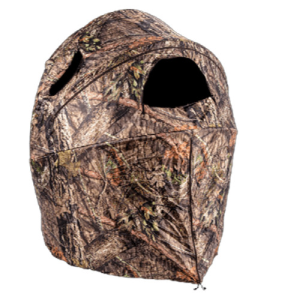
This one is a niche pick, but it solves a specific problem well. The Tent Chair is exactly what it sounds like: a chair with a pop-up blind built around it. One piece. You carry it like a backpack chair, pop it open, sit down, and you're hunting. The interior space is minimal, essentially just enough for you and a rifle across your lap. The shooting windows are small. But for a solo rifle hunter who wants concealment on public land without the hassle of setting up a full blind and a separate chair, it's a clever solution. The weight runs around 14 pounds, which is heavier than a chair alone but lighter than a chair plus a blind. The durability isn't on par with a Double Bull or a Barronett, and wind can be an issue since the footprint is small and top-heavy. But for quick sits in timber where you're hunting a specific trail crossing, it works.
Ameristep Tent Chair Blind Deals
Prices may change. May contain affiliate links.
Common mistakes rifle hunters make with ground blinds
Setting up on opening day
Deer notice new objects in their environment. A ground blind that appears overnight on the edge of a food plot will get stared at, circled, and avoided by mature deer for days or even weeks. Set your blind up at least two to three weeks before the season. Brush it in with natural vegetation from the area. Let the deer get used to it as part of the landscape. On public land where you can't leave a blind for weeks, set up well before first light and add natural cover. Even a few hours of the blind sitting empty before you hunt it helps.

Ignoring scent control inside the blind
A ground blind traps scent. Your breath, your coffee, your body odor, the off-gassing from new fabric. All of it pools inside the blind and vents out through the windows. New blinds should be aired out for several days before hunting season. Some hunters spray the interior with scent eliminator or leave activated carbon bags inside during storage. The fabric itself picks up and holds odors from your garage, your truck, and your gear bag. Treat the inside of your blind like you'd treat your hunting clothes.
Sitting too high
The natural instinct is to sit in a tall chair so you can see out the windows easily. The problem is that a tall seating position puts your head and shoulders above the window line, silhouetting you against the back wall of the blind. Sit low. Your eyes should be at or just below the midpoint of the shooting window. A low hunting chair with a 15 to 18-inch seat height works for most blinds. Shooting sticks or a window-mounted rest should position the rifle at a height that matches your seated eye level to the scope.
Opening too many windows
More windows means more light inside the blind, and more light means deer can see your movement. Open only the windows you need for your shooting lanes. Keep the back and side windows closed unless you need ventilation in warm weather. A bright interior turns the blind into a display case. The goal is to keep the inside as dark as possible relative to the outside, so your movement disappears into shadow.
Forgetting about muzzle blast
This one is specific to rifle hunters and almost never discussed. When you fire a rifle inside a ground blind, the muzzle blast hits the fabric walls, the window edges, and sometimes the mesh. If your muzzle is too close to the window, the blast can damage the fabric, blow the mesh out of its track, and create a pressure wave inside the blind that's disorienting. Make sure the muzzle extends at least a few inches past the window opening. If you're shooting through mesh, remove the mesh from that window entirely before the shot. A muzzle brake makes this worse by redirecting gas sideways. If you hunt with a braked rifle inside a blind, you need wider window openings and more muzzle clearance.
Field notes: the details that don't make the spec sheet
The chair you sit in matters almost as much as the blind itself. A wobbly, creaky chair will cost you more deer than a slightly inferior blind. Look for a chair with a swivel base, minimal metal-on-metal contact points, and a seat height that puts your eyes at the right level for your specific blind's window height. The Millennium G-100 and similar low-profile swivel chairs are popular for a reason. They're quiet, stable, and the right height for most hub blinds.

Ground stakes are not optional, even on calm days. A gust of wind can lift an unstaked blind off the ground and send it tumbling across a field. Use heavy-duty stakes at every anchor point, and add extra guylines in open terrain. On frozen ground, bring longer stakes or screw-in anchors.
Condensation is a real problem during late-season hunts. Your breath and body heat create moisture inside the blind that fogs optics, dampens clothing, and makes everything clammy. Crack a downwind window slightly to create airflow. Keep a lens cloth accessible. Some hunters run a small silica gel pack near their scope to absorb moisture.
Black interior fabric is standard on quality blinds for a reason. It absorbs light and hides your outline. If your blind has a lighter interior, you can improve it by hanging black fabric or dark mesh on the back wall behind your seating position. Cheap blinds with gray or green interiors are a compromise that costs you concealment.
Getting your blind setup dialed before the season
Don't wait until November to figure out how your rifle, your chair, your shooting rest, and your blind work together. Set the blind up in your yard or at the range. Sit in it with your actual hunting chair and your actual rifle. Practice acquiring a target through the scope from a seated position. Swing left and right to find the limits of your shooting arc. Figure out which windows need to be open and which stay closed.
If your range allows it, shoot from inside the blind. You'll immediately discover problems you didn't anticipate: the scope eye relief feels different when you're hunched slightly, the rifle balance changes on a different rest than your bench setup, the muzzle is closer to the window frame than you thought. These are problems you want to solve in September, not when a buck steps out at 80 yards on opening morning.

Run a dry-fire drill where you start with the rifle across your lap, safety on, and practice bringing it up to the shooting window, settling onto the rest, finding the target in the scope, clicking the safety off, and pressing the trigger. Time yourself. Do it until the movement is smooth and quiet. Then do it in the dark with a headlamp off, because that's how the first few minutes of legal shooting light feel inside a blind. The gear is only as good as the hunter running it. A $500 blind won't help you if you're fumbling with your rifle when the moment comes. Smooth is fast, and fast is what you need when a deer gives you a 10-second window at first light.