You're looking at an M1A and trying to figure out which one you're actually holding. Or maybe you're shopping and the lineup has gotten confusing enough that "Standard," "Loaded," "National Match," and "SOCOM" all blur together. The differences between these rifles aren't cosmetic fluff. They're barrel profiles, trigger groups, sight configurations, bedding work, and stock architecture that fundamentally change what the rifle does well and what it's worth on the secondary market.

This guide breaks down the current Springfield Armory M1A lineup, explains the markings and features that distinguish each variant, and gives you a realistic picture of what these rifles command in 2026. The M1A product line has been produced by Springfield Armory since 1974, and the model catalog has expanded significantly. Knowing exactly what you're buying or selling matters more now than it ever has.
Who this guide is for
If you're evaluating an M1A purchase, trying to identify a used rifle by its model number and features, or wondering whether the price gap between a Standard and a Loaded is justified, this is your reference. Budget range runs from the mid-$1,400s on the used market up past $5,000 for a Super Match. You should already know what a .308 Win. semi-auto is and roughly what the M14 heritage means. This isn't a "what is a battle rifle" primer.
Quick picks
- Springfield Armory M1A Standard Issue Best for classic M14 feel and entry into the platform
- Springfield Armory M1A Loaded Best for accuracy upgrades without match-rifle pricing
- Springfield Armory M1A National Match Best for competition shooters who want a turnkey match rifle
- Springfield Armory M1A Super Match Best for maximum precision from the factory
- Springfield Armory M1A SOCOM 16 Best for a compact .308 that handles fast
- Springfield Armory M1A Scout Squad Best for a versatile mid-length do-everything rifle
- Springfield Armory M1A Tanker Best for traditionalists who want short-barrel handling in walnut
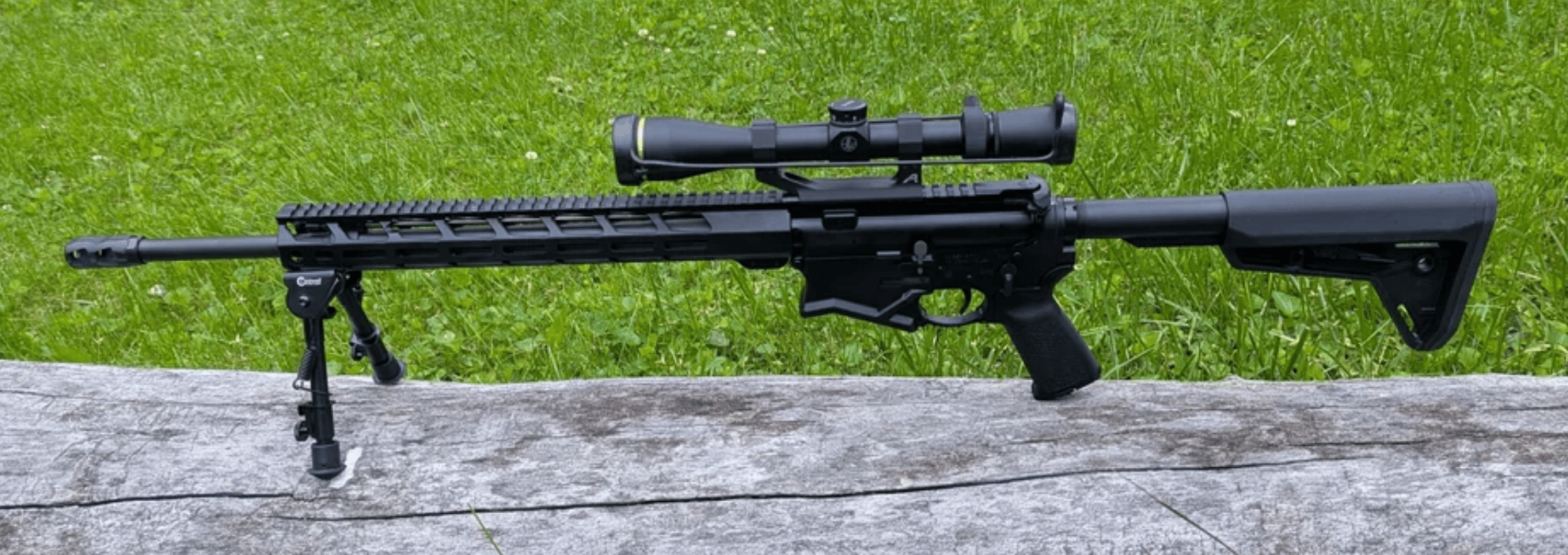
At a glance
How we chose
The M1A lineup is all one manufacturer, all one action, all one gas system. The differences come down to barrel spec, trigger tuning, stock type, sight configuration, and bedding. Those are the variables that actually change how the rifle performs and what it's worth.
Selection here is based on the distinct role each variant fills. The Standard Issue is the baseline. The Loaded adds the barrel and trigger upgrades that most shooters would eventually want anyway. The National Match and Super Match are purpose-built competition guns with progressively more hand-fitting. The short-barrel variants split between tactical (SOCOM 16), scout-concept (Scout Squad), and heritage-aesthetic (Tanker). Each one occupies a genuinely different niche rather than being a cosmetic reshuffling.
Reliability across the M1A line is generally consistent because the operating system is the same: gas-operated with an operating rod and rotating bolt, the same fundamental mechanism as the M14 and, before it, the M1 Garand. Springfield Armory has been building these since 1974, and the cast steel receiver is shared across the lineup. What changes between models is precision potential and handling character, not mechanical reliability.
The value discussion leans heavily on the used market because that's where most M1A transactions happen. Replacement of commercial parts with genuine USGI surplus components can actually increase value among knowledgeable buyers, which is unusual in the rifle world and worth understanding before you modify anything.
The picks
Springfield Armory M1A Standard Issue
Best for: classic M14 feel and entry into the platform
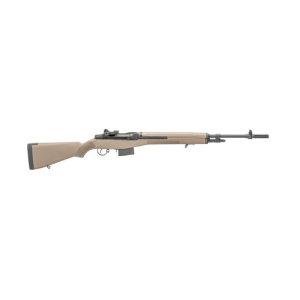
Springfield Armory M1A Standard Issue Deals
Prices may change. May contain affiliate links.
The Standard Issue is the foundation of the entire line and the closest thing to the original M14's look and feel in a civilian semi-auto package. It runs a 22-inch barrel, a two-stage military trigger, a long slotted flash suppressor, and comes in either walnut or synthetic stocks. Overall length is 44.33 inches, and weight sits around 9 lbs 3 oz empty for the walnut stock version or 8 lbs 8 oz for the black composite stock version. That's not a featherweight, but the heft is part of the shooting experience. The .308 Win. cartridge out of a 22-inch barrel gives you full velocity potential, and the adjustable aperture rear sight paired with a hooded post front sight is the traditional M1A sighting system.
The Standard Issue has been in production longer than any other variant, and it's the most common M1A on the used market. New MSRP runs $1,808 to $1,914. On the secondary market, used Standard Issue rifles typically command $1,400 to $1,900 depending on condition, with the current average for a used model sitting in the $1,350 to $1,370 range based on late 2025 market data. That slight softening makes the Standard a reasonable entry point if you're patient and shop used.
The barrel is a standard-weight profile, the trigger is the military-spec two-stage unit (not the National Match tuned version), and the stock is not glass-bedded. These are the three areas where the Loaded and National Match variants improve on the Standard. If you're planning to upgrade barrel, trigger, and bedding over time, starting with a Standard and adding parts incrementally is a viable path, and some experienced M1A owners prefer it.

Pros
- Closest to original M14 configuration
- Walnut stock option preserves classic aesthetics
- Most affordable new M1A
- Largest used market availability
- Full 22-inch barrel for maximum .308 velocity
Cons
- Standard-weight barrel heats faster than medium-weight NM barrels
- Military trigger is functional but noticeably heavier than NM-tuned units
- Stock is not glass-bedded from the factory
- No scope mount included; requires aftermarket purchase
Springfield Armory M1A Loaded
Best for: accuracy upgrades without match-rifle pricing
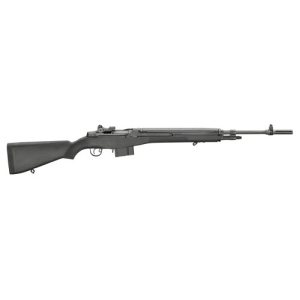
Springfield Armory M1A Loaded Deals
Prices may change. May contain affiliate links.

The Loaded is where the M1A starts to get serious about precision. It takes the Standard Issue platform and adds the three upgrades that matter most: a medium-weight premium air-gauged National Match barrel with a 22-inch, 1:11-inch twist, a National Match tuned two-stage trigger pulling at 4.5 to 5 pounds, and a National Match 0.062-inch front sight blade. The rear sight gets a smaller aperture (0.0520 inches) with half-MOA windage adjustments and one-MOA elevation increments. That's a meaningfully finer sight picture than the Standard Issue provides.
Here's the real talk on the Loaded's rear sight, though. Springfield calls it a "match" rear sight, but it's technically a standard rear sight base with a smaller aperture hole. It is not the hooded, rotating NM rear sight with NM-marked base and NM windage knob that you get on the actual National Match model. That distinction matters if you're comparing spec sheets, and it's one of the most common points of confusion in the M1A world.
The Loaded is the only M1A variant available in both .308 Win. and 6.5 Creedmoor, which opens up the platform to shooters who want the M1A action with a flatter-shooting, lower-recoil cartridge for longer-range work. The 6.5 Creedmoor versions come with a black composite fixed stock, though a Precision Adjustable Stock version is also available in 6.5 Creedmoor. In .308, you can get walnut, synthetic, or the Archangel Precision Adjustable stock (the Loaded Precision sub-variant). MSRP for the standard Loaded configurations ranges from $1,978 to $2,103 depending on configuration, while the Loaded Precision variant has an MSRP of $2,149.
Accuracy testing with quality ammunition has shown the Loaded capable of sub-2 MOA groups at 100 yards, and further bedding and tuning can tighten that. The medium-weight NM barrel also offers longer barrel life compared to the Standard's lighter profile, which is a practical consideration if you shoot volume. The trigger alone is worth the step up. The difference between the military two-stage unit and the NM-tuned 4.5-pound trigger is something you feel on every shot.
Pros
- National Match barrel and trigger at a lower price than the National Match model
- Only M1A available in 6.5 Creedmoor
- Multiple stock options including the Archangel Precision Adjustable
- Sub-2 MOA accuracy potential with quality ammunition
- Medium-weight barrel profile improves barrel life
Cons
- Rear sight is not a true NM hooded aperture despite "match" labeling
- Action is not glass-bedded from the factory
- 6.5 Creedmoor only available with black composite stock
- Still 10+ pounds; not a light carry rifle

Springfield Armory M1A National Match
Best for: competition shooters who want a turnkey match rifle

Springfield Armory M1A National Match Deals
Prices may change. May contain affiliate links.
The National Match takes everything the Loaded does and adds the finishing touches that competitive shooters need. The action is glass-bedded into the walnut stock, which means the receiver is custom-fitted into the stock with a fiberglass compound to eliminate movement and create a consistent, rigid platform. That bedding work is the single biggest accuracy differentiator between the Loaded and the National Match.
The rear sight is the real deal here: a micro-adjustable match-grade hooded aperture with half-MOA elevation adjustments. The hooded design shields the aperture from glare and gives you a cleaner sight picture in variable lighting. The National Match also gets a match spring guide, which the Loaded does not. Combined with the same NM barrel and NM-tuned 4.5- to 5-pound two-stage trigger found in the Loaded, the National Match is a rifle built from the factory to go straight to the competition line at Camp Perry.
One thing worth noting: Springfield Armory's website currently lists the National Match as discontinued. The walnut-stocked carbon barrel version (NA9102) and the stainless barrel version have been produced from 1984 through at least 2010, and rifles are still available through dealers and on the secondary market. Whether Springfield will bring it back or fold its features into the Loaded Precision line remains to be seen. On the used market, National Match and Super Match models represent the apex of M1A values, and competition-grade variants command significantly more than Standard or Loaded rifles.

Pros
- Glass-bedded action for maximum accuracy consistency
- True NM hooded rear sight with micro-adjustable aperture
- Match spring guide included
- Purpose-built for NRA High Power and similar competition
- Strong collector and resale value
Cons
- Currently listed as discontinued by Springfield Armory
- Higher price point than the Loaded for features some shooters won't fully exploit
- Walnut stock only; no synthetic or chassis options from the factory
- Glass bedding means you should avoid frequent field stripping of the stock
Springfield Armory M1A Super Match
Best for: maximum precision from the factory

Springfield Armory M1A Super Match Deals
Prices may change. May contain affiliate links.
The Super Match is the top of the M1A food chain. It takes the National Match concept and pushes it further with a rear-lugged action that's glass-bedded into an oversized McMillan fiberglass stock. The rear-lugged receiver is a significant mechanical difference. It adds a lug at the rear of the receiver that locks into the stock, creating an additional point of contact that reduces receiver movement under recoil. That's the kind of detail that separates a good match rifle from a great one.

Everything else is top-shelf: NM barrel, NM trigger, NM sights, and the kind of hand-fitting that you'd normally pay a gunsmith to do after purchase. The McMillan stock is wider and heavier than standard M1A stocks, which adds stability in prone and bench shooting positions. Super Match models can exceed $5,000 on the market, and they represent the smallest production numbers in the M1A lineup.
Forum discussion among competitive shooters suggests the Super Match is the clear choice if you're committed to M1A-platform competition and want everything done right from the factory. The National Match is the step below, and the gap between them is the rear-lugged action and the oversized stock. Whether that gap justifies the price difference depends entirely on how seriously you shoot.
Pros
- Rear-lugged receiver for superior bedding stability
- Oversized McMillan fiberglass stock
- Highest factory accuracy potential in the M1A line
- All National Match barrel, trigger, and sight components
- Strong collector and competition value
Cons
- Highest price in the M1A lineup by a significant margin
- Heavy; the oversized stock adds weight
- Not practical for field use or hunting
- Limited availability

Springfield Armory M1A SOCOM 16
Best for: a compact .308 that handles fast

Springfield Armory M1A SOCOM 16 Deals
Prices may change. May contain affiliate links.

XS Sights tritium front sight Deals
Prices may change. May contain affiliate links.
The SOCOM 16 chops the barrel to 16.25 inches and mates it to the gas system with a proprietary muzzle brake designed to reduce felt recoil. Overall length drops to 37.25 inches and weight comes down to about 8 pounds 8 ounces with an empty magazine. That's a meaningful reduction from the 44.3-inch, 10.4-pound Standard Issue. The SOCOM was designed in 2004 and has been one of Springfield's most popular M1A variants since.
Sights on the standard SOCOM 16 are an XS Sights tritium insert in the front sight paired with an enlarged ghost ring aperture rear sight, adjustable for windage and elevation. Synthetic-stocked versions include a forward Picatinny rail for mounting a scout-style optic. The muzzle velocity takes a hit from the shorter barrel, dropping to approximately 2,500 ft/s compared to what you'd get from a 22-inch tube, but the handling advantage is substantial.
The SOCOM 16 CQB variant (model AA9611) adds the Archangel stock with a pistol grip, 5-position collapsible buttstock, and M-Lok slots at 3, 6, and 9 o'clock for detachable rail sections. MSRP on the standard SOCOM 16 is $2,129; the CQB runs $2,298. Both are .308 Win. only. This is not a precision rifle. Most M1A models outside the match grades aren't going to deliver sub-MOA groups, and 8x magnification is generally more than enough for the SOCOM's effective envelope.
Pros
- Most compact standard M1A variant at 37.25 inches overall
- Proprietary muzzle brake reduces felt recoil
- Tritium front sight for low-light acquisition
- CQB variant adds modern ergonomics with Archangel stock
- Lightest full-featured M1A at roughly 8 lbs. 9 oz.
Cons
- 16.25-inch barrel sacrifices velocity compared to 22-inch models
- Not a precision platform; accuracy expectations should be realistic
- Ghost ring rear sight is faster but less precise than aperture sights
- Still a .308 rifle; not ideal for true CQB or indoor use

Springfield Armory M1A Scout Squad
Best for: a versatile mid-length do-everything rifle
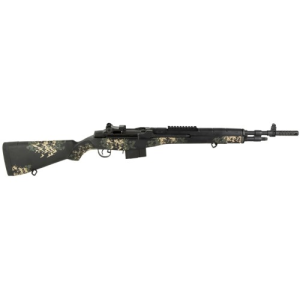
Springfield Armory M1A Scout Squad Deals
Prices may change. May contain affiliate links.
The Scout Squad splits the difference between the full-size 22-inch rifles and the 16.25-inch SOCOM variants with an 18-inch, 1:11-inch twist carbon steel barrel. It comes with a forward scout-style Picatinny rail already installed, which is the key feature that separates it from other M1A models. That forward rail position is designed for scout-scope or red-dot mounting, giving you both-eyes-open shooting with fast target acquisition.
The trigger is a 5-pound NM-tuned two-stage unit, which is slightly heavier than the Loaded's 4.5-pound spec but still a step above the Standard Issue's military trigger. Stock options include walnut and black synthetic. MSRP ranges from $1,982 to $2,129 depending on configuration.
The Scout Squad concept traces back to Jeff Cooper's scout rifle idea: a general-purpose rifle that's light enough to carry, powerful enough for medium game, and fast enough to get on target in a hurry. The M1A Scout Squad isn't a perfect scout rifle by Cooper's strict definition (it's too heavy for that), but the 18-inch barrel and forward optic mount put it in the right neighborhood. For hunting, brush work, or a truck gun that can also reach out past 300 yards, the Scout Squad is the most versatile M1A in the catalog.
Pros:
- 18-inch barrel balances velocity and handling
- Forward Picatinny rail included from the factory
- NM-tuned trigger standard
- Available in walnut or synthetic
- Best M1A for mixed-role use: range, hunting, utility
Cons:

- Heavier than a true scout rifle concept demands
- 18-inch barrel still loses some velocity vs. 22-inch models
- No 6.5 Creedmoor option
- Forward rail limits optic choices to scout scopes and red dots for ideal eye relief
Springfield Armory M1A Tanker
Best for: traditionalists who want short-barrel handling in walnut

Springfield Armory M1A Tanker Deals
Prices may change. May contain affiliate links.
The Tanker takes the SOCOM 16's 16.25-inch barrel and mechanical package and wraps it in a classic walnut stock. The name references the T26 Tanker variant of the M1 Garand, and the aesthetic connection is intentional. You get the same tritium front sight and ghost ring rear as the SOCOM 16, the same proprietary muzzle brake, and the same compact dimensions, but with the warmth of stained walnut instead of black synthetic.
MSRP is $2,129, the same as the standard SOCOM 16. The Tanker has been produced intermittently, with model number AA9622 available from 2019 through 2020 and again from 2023 through 2025. It's a niche product that appeals to a specific buyer: someone who wants a short, handy .308 semi-auto but doesn't want the tactical look. If that's you, there's nothing else quite like it in the M1A catalog.
Pros
- Walnut stock on a compact 16.25-inch barreled action
- Tritium front sight and ghost ring rear for fast acquisition
- Proprietary muzzle brake reduces felt recoil
- Heritage aesthetic inspired by the T26 Tanker Garand
- Same price as the synthetic SOCOM 16
Cons
- Walnut adds some weight compared to synthetic SOCOM stocks
- Same velocity and accuracy limitations as any 16.25-inch M1A
- Intermittent production; availability can be spotty
- No forward Picatinny rail like the Scout Squad
How to choose
First, decide on barrel length. The 22-inch rifles (Standard, Loaded, National Match, Super Match) maximize .308 velocity and accuracy potential. The 18-inch Scout Squad is the middle ground. The 16.25-inch models (SOCOM 16, Tanker) prioritize handling and compactness. If you're going to shoot past 400 yards regularly, the longer barrels make a real difference.

Springfield Armory 4th Generation scope mount Deals
Prices may change. May contain affiliate links.
Second, decide how much accuracy work you want done at the factory. The Standard gives you a blank canvas. The Loaded adds the NM barrel and trigger, which are the two most impactful upgrades. The National Match adds glass bedding and true NM sights. The Super Match adds the rear-lugged receiver and oversized stock. Each step costs more, and each step delivers diminishing returns unless you're actually shooting at a level that demands it.
Third, consider the secondary market. M1A values are well-documented. Standard Issue rifles have softened slightly, with used models averaging $1,350 to $1,370 in late 2025. Competition and match-grade variants hold value much better. If you're buying used, one unusual M1A trait is that replacing commercial parts with genuine USGI surplus components can increase the rifle's value among knowledgeable buyers. That's the opposite of most modern rifles, where aftermarket parts reduce resale value.
Fourth, if you want 6.5 Creedmoor, the Loaded is your only option. No other M1A variant is chambered for it. That narrows the decision considerably if the cartridge is a priority.
Fifth, think about optics mounting. The M1A doesn't come with a scope mount on most models (the Scout Squad's forward rail is the exception). Springfield sells a 4th Generation scope mount as an accessory, but it's an additional purchase and adds height over bore. If you want a rifle that's ready for glass out of the box, the Scout Squad is the most straightforward path. Otherwise, budget for the mount separately.
Common mistakes and troubleshooting
The most frequent M1A identification error is confusing the Loaded's rear sight with a true National Match rear sight. The Loaded uses a standard rear sight base with a smaller aperture. The National Match uses a hooded, rotating rear sight with an NM-marked base and NM windage knob. If you're buying a used rifle advertised as a National Match, check the rear sight first. That hooded aperture is the quickest visual confirmation.
Model numbers tell you exactly what you have. The M14 Forum maintains a comprehensive list of Springfield Armory M1A stock numbers cross-referenced with descriptions and production years. For example, NA9102 is the National Match with commercial walnut stock, produced from 1984 through 2010. MA9222 is the Loaded with walnut stock. AA9611 is the SOCOM 16 CQB with Archangel stock, produced from 2015 through 2025. If you have the model number from the rifle, you can identify the exact variant and production window.
Glass bedding on the National Match and Super Match models means you should minimize how often you remove the stock. Each time you separate the action from a bedded stock and reassemble, you risk degrading the fit. Clean and lubricate through the action without pulling the barreled action out of the stock whenever possible.
Aftermarket accessories rarely increase the resale value of an M1A. Chassis systems, optics, and slings are better sold separately. Price the rifle based on its base model and condition, then offer accessories as an optional package. Buyers want to know what the base gun is, not what you bolted onto it.
The gas system on all M1A variants is the same operating rod and rotating bolt design. If you're experiencing short-stroking or cycling issues, aftermarket upgrades like an adjustable gas valve and a match spring guide (roughly $200 for the combination) can significantly improve reliability and tighten groups. These are the upgrades that experienced M1A owners point to as having the biggest functional impact per dollar spent.
Next steps
Before you buy, confirm the model number against Springfield's published stock number list and verify it matches the features on the rifle. Check the rear sight type, barrel profile, and stock configuration. On a used rifle, inspect the gas system and bore condition carefully. M1A rifles that were shot with corrosive ammunition and not cleaned promptly can have pitted bores and seized gas assemblies, but even rifles in that condition have been brought back to shooting shape with work.
If you're buying new, decide whether the Loaded's barrel and trigger upgrades justify the step up from the Standard. For most shooters who plan to keep the rifle long-term and actually use it, the answer is yes. The NM barrel and trigger are the two components that affect your shooting experience on every single round.
Once you have the rifle, run a function check before anything else. Confirm the safety engages and disengages cleanly, the trigger resets properly, and the action cycles smoothly by hand. Then put 50 to 100 rounds of quality brass-cased .308 through it before forming any accuracy opinions. The M1A action needs a brief settling-in period, and the gas system runs best when it's lightly oiled and broken in. After that initial range session, you'll know what you're working with and whether the rifle matches the variant it's supposed to be.