Your AR-10 weighs nine pounds empty and feels like a boat anchor after a day of hunting. You've been eyeing lightweight builds but don't want to sacrifice .308 performance for a few ounces. Ruger's SFAR might be exactly what you're looking for; they squeezed .308 Winchester into an AR-15-sized receiver and knocked nearly two pounds off a traditional large-frame platform.
The Small Frame Autoloading Rifle (SFAR) weighs 7.1 pounds with a 16.1-inch barrel, compared to 8.8-9.5 pounds for most AR-10s. That's not just marketing math; it's the difference between carrying a rifle all day and wishing you'd brought your bolt gun instead. But weight savings usually come with compromises, and I wanted to know exactly what you're trading off.
After running the SFAR through accuracy testing, reliability drills, and comparing it against traditional AR-10s, here's what actually matters for your next .308 build decision.
How Ruger shrunk the .308 platform
The SFAR uses AR-15 upper and lower receiver dimensions with a redesigned bolt carrier group and barrel extension. Instead of the larger AR-10 platform that needs more receiver real estate for the longer .308 cartridge, Ruger engineered a bolt that cycles within AR-15 constraints.
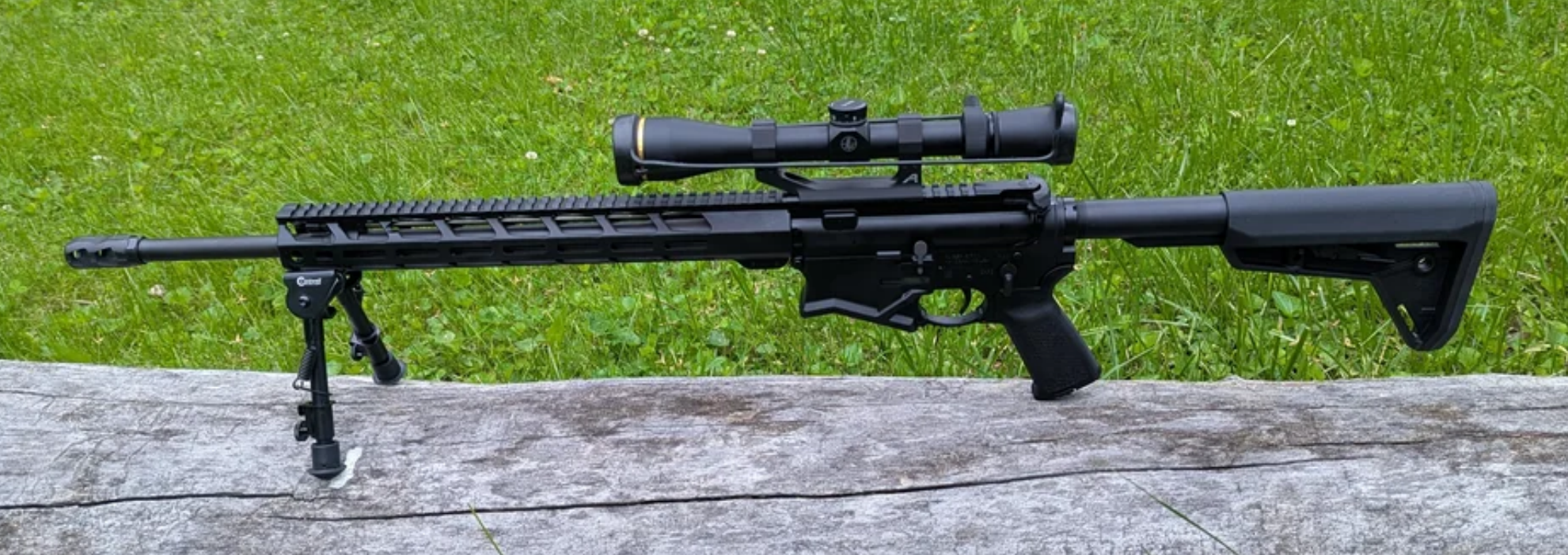
The key difference is in the bolt carrier. Traditional AR-10 carriers are longer to accommodate .308's overall length, but Ruger's carrier uses a different geometry that compresses the cycling distance. The bolt face still handles full-power .308 pressures, around 62,000 PSI, but the carrier group fits in a standard AR-15 upper receiver.
This isn't just about making things smaller. The reduced receiver size means less material, which directly translates to weight savings. Your standard AR-10 upper receiver weighs about 12-14 ounces, while the SFAR's AR-15-sized upper comes in around 8-9 ounces. Multiply that across all the components, and you get meaningful weight reduction without exotic materials.
The barrel uses a standard .308 chamber and bore, so ballistics remain identical to any other 16-inch .308. You're not giving up velocity or energy, just receiver bulk.
Range notes: First 500 rounds
I ran the SFAR through initial break-in with Federal Gold Medal Match 168-grain and some bulk Winchester 147-grain FMJ. The rifle needed about 50 rounds to settle in, which is typical for any new gas gun. Early groups were around 1.5 MOA, tightening to consistent 1-1.2 MOA after the barrel seasoned.
The 16.1-inch barrel delivers 2,650 fps with 168-grain match ammo, which is within 50 fps of what I see from other 16-inch .308s. The gas system is properly tuned, ejection pattern stays at 3-4 o'clock with various loads, and brass shows normal extraction marks without over-pressure signs.
Recoil impulse feels sharper than a heavier AR-10 but more controlled than I expected from a 7-pound .308. The adjustable gas block lets you tune for different loads, though I found the factory setting worked fine for everything from 147-grain ball to 175-grain match.
The trigger breaks cleanly at about 6 pounds with minimal creep. It's not a precision trigger, but it's predictable enough for hunting accuracy. Reset is positive with a distinct tactile click.
Accuracy testing: What to expect
I tested five different loads through the SFAR to establish realistic accuracy expectations. All groups were five-shot strings at 100 yards from a bench with a bipod.
Federal Gold Medal Match 168-grain consistently printed 1.1-1.3 MOA groups. This became my baseline load, the rifle clearly prefers match-grade ammo with this bullet weight. Hornady ELD Match 168-grain performed similarly, averaging 1.2 MOA across multiple sessions.
Winchester 147-grain FMJ opened up to 1.8-2.1 MOA, which is acceptable for a hunting rifle but shows the SFAR responds to quality ammunition. Federal Power-Shok 150-grain soft points grouped around 1.6 MOA, better than ball ammo but not match grade.
The surprise performer was Hornady Black 168-grain A-MAX, which consistently shot sub-MOA groups averaging 0.9 MOA. This load seems to hit the SFAR's sweet spot for both accuracy and reliable cycling.
Cold bore shots landed within 0.5 MOA of group center, which matters more for hunting than absolute group size. The barrel doesn't seem to walk as it heats up, maintaining point of impact through 20-round strings.
Accuracy Results, Ruger SFAR .308 Win.
* 5-shot groups | 100 yards | Bench with bipod. Cold bore shots within 0.5 MOA of group center.
Reliability and cycling issues
The SFAR ran 500 rounds without a single malfunction using quality brass-cased ammunition. Federal, Hornady, and Winchester all cycled reliably with proper ejection and consistent lockback on empty magazines.
Steel-cased ammo tells a different story. Tula and Wolf both caused extraction issues around round 50-75, with cases sticking in the chamber. This isn't uncommon for .308 rifles with tighter chambers, but it's worth noting if you plan to shoot a lot of budget steel case.
The bolt hold-open works consistently with Magpul and Ruger magazines. I tested with both 10 and 20-round magazines without issues. The magazine well accepts standard SR-25 pattern magazines, so you're not locked into proprietary feeding systems.
Gas adjustment takes some experimentation. The factory setting runs reliably with 147-168 grain loads, but lighter bullets might need adjustment for optimal cycling. Heavier 175-180 grain bullets sometimes short-stroke on the factory setting, requiring one click more gas.
Build quality and component analysis
The SFAR's receiver set uses 7075-T6 aluminum with a hard-coat anodized finish. Fit between upper and lower is tight with no wobble, and the finish quality matches what I expect from Ruger. The barrel extension headspace checked out at 1.630 inches, right in the middle of the spec range.
The bolt is properly staked and shows quality heat treatment. After 500 rounds, wear patterns look normal with no excessive peening or cracking around the lugs. The extractor maintains proper tension, and the ejector spring shows no signs of weakening.
The barrel is button-rifled with a 1:10 twist rate, which stabilizes bullets from 150-180 grains effectively. The crown is recessed and well-finished. The gas port measures 0.093 inches, which is appropriately sized for the 16-inch barrel length.
The handguard uses M-LOK attachment points and feels solid under load. I mounted a bipod and scope without any flex or shifting. The rail extends 13 inches, providing plenty of real estate for accessories.
Weight comparison with traditional AR-10s
Here's how the SFAR stacks up against comparable .308 semi-autos:
The Springfield Saint Victor .308 weighs 8.8 pounds with a 16-inch barrel. That's 1.7 pounds heavier than the SFAR, mostly in the receiver set and bolt carrier group. The Aero Precision M5E1 complete rifle comes in around 9.2 pounds, while a basic DPMS pattern build typically weighs 8.5-9.0 pounds.
For context, a Ruger American Ranch bolt-action .308 weighs 6.1 pounds, so the SFAR splits the difference between bolt-action portability and semi-auto capability. You're paying one pound for the gas system and magazine capacity.
The weight distribution feels balanced. The SFAR doesn't feel muzzle-heavy like some AR-10s with thick barrels. Shouldering and transitioning between targets feels more like handling an AR-15 than a traditional large-frame rifle.
Magazine compatibility and feeding
The SFAR uses SR-25 pattern magazines, which means compatibility with Magpul PMAG 20 LR/SR, Knights Armament, and most quality .308 AR magazines. I tested Magpul 10 and 20-round magazines extensively without feeding issues.
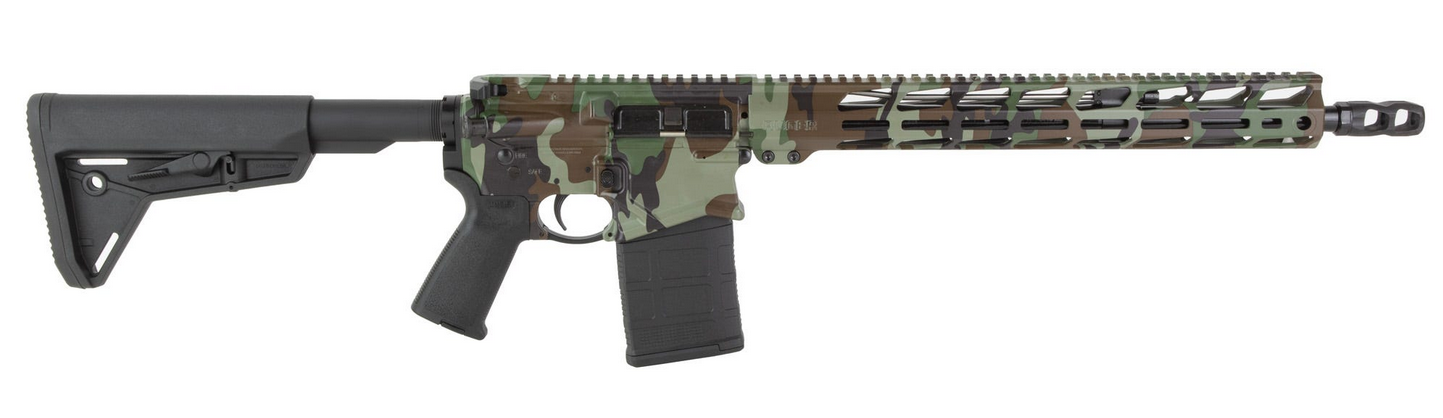
Cheaper magazines can cause problems. Some off-brand 20-rounders failed to lock back on empty or caused double-feeds. Stick with proven magazine manufacturers, the rifle is reliable when fed properly, but it won't overcome poor magazine quality.
Loading 20 rounds in Magpul magazines requires firm seating. The spring tension is high enough that partially seated magazines can cause feeding issues. This is normal for .308 magazines but worth mentioning for new users.
The magazine release works smoothly and drops magazines cleanly. I didn't experience any magazines hanging up or requiring excessive force to remove.
Common problems and troubleshooting
Short-stroking with heavy bullets: Bullets over 175 grains sometimes fail to fully cycle on the factory gas setting. Adjust the gas block one click open and test function with your specific load.
Extraction issues with steel case: The chamber dimensions seem tight enough that lacquered steel cases occasionally stick. This clears up after about 100 rounds of break-in, but brass-cased ammo runs more reliably.
Magazine seating: Some users report magazines not seating fully on a closed bolt. This usually indicates the magazine catch needs slight adjustment or the magazine isn't being inserted with enough force.
Scope mounting height: The rail height requires medium or high scope rings for proper eye relief. Low rings put most scopes too close to the charging handle for comfortable operation.
Gas block alignment: A few rifles shipped with slightly misaligned gas blocks causing cycling issues. This requires professional adjustment but is covered under warranty.
Suppressor compatibility
The SFAR's adjustable gas block makes it suppressor-friendly with proper tuning. Running a SilencerCo Omega 300 required closing the gas block two clicks from the factory setting to prevent over-gassing.
The 5/8x24 thread pitch accepts most .30-caliber suppressors directly. The barrel shoulder provides solid support for heavier cans without additional support devices.
Suppressed accuracy actually improved slightly, with match loads grouping around 1.0 MOA consistently. The added weight and barrel harmonics seem to benefit precision, though the difference is marginal.
Optics and mounting considerations
The SFAR's rail height works well with most variable power scopes in medium rings. I tested with a Vortex Viper PST Gen II 3-15x44, which provided proper eye relief and comfortable cheek weld with Warne medium rings.
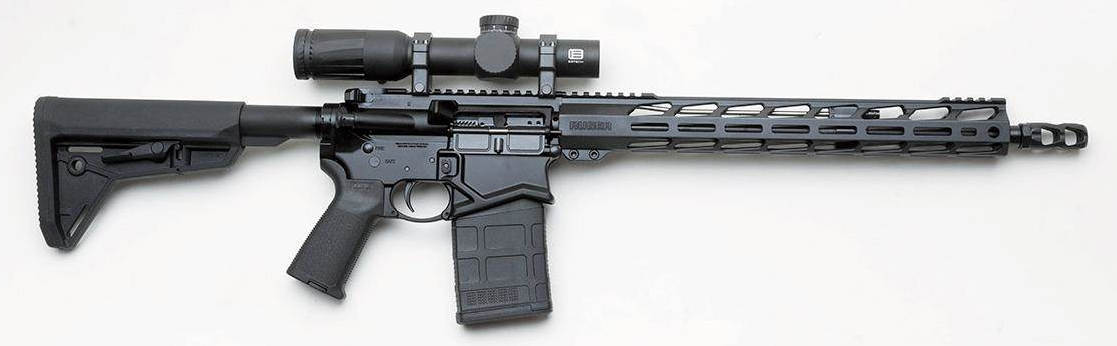
Red dots mount lower to the bore axis than on traditional AR-10s, which can be an advantage for quick target acquisition. An Aimpoint PRO sits about 0.2 inches lower than on a standard AR-10 rail.
The rail extends far enough forward for proper scope positioning without interfering with the gas block adjustment. Most scopes in the 3-15x or 4-16x range will fit comfortably with room for accessories.
Build notes: Upgrades and modifications
The SFAR accepts most AR-15 furniture, which opens up significant customization options. I swapped the factory stock for a Magpul PRS Gen 3, which improved stability for precision shooting without adding excessive weight.
The trigger group uses standard AR-15 components, so upgrades are straightforward. A Geissele SSA-E dropped right in and improved the trigger break to 3.5 pounds with minimal creep.
The handguard can be replaced with any AR-15 compatible rail system, though you'll need to work around the proprietary barrel nut. Most users find the factory handguard adequate for their needs.
The charging handle uses AR-15 dimensions, so upgrades like the Radian Raptor or BCM Gunfighter fit without modification.
Comparison with alternatives
Springfield Saint Victor .308: Heavier at 8.8 pounds but uses standard AR-10 components for easier parts availability. Accuracy is comparable, but the weight difference is noticeable during extended carry.
Aero Precision M5E1: Traditional AR-10 platform with excellent build quality and wide parts compatibility. Weighs about 9 pounds but offers more upgrade paths and component choices.
POF Revolution: Another lightweight .308 design weighing 7.3 pounds. Similar concept to the SFAR but uses a different engineering approach. Generally more expensive but offers some unique features.
LWRC REPR MKII: Premium option at 8.2 pounds with excellent build quality. Significantly more expensive than the SFAR but offers enhanced reliability and accuracy potential.
The SFAR sits in a unique position, lighter than traditional AR-10s but using a proven manufacturer's engineering rather than boutique pricing.
Who should buy the SFAR
The SFAR makes sense if you want .308 performance in a package that carries like an AR-15. Hunters who cover a lot of ground will appreciate the weight savings, especially in mountainous terrain where every ounce matters.
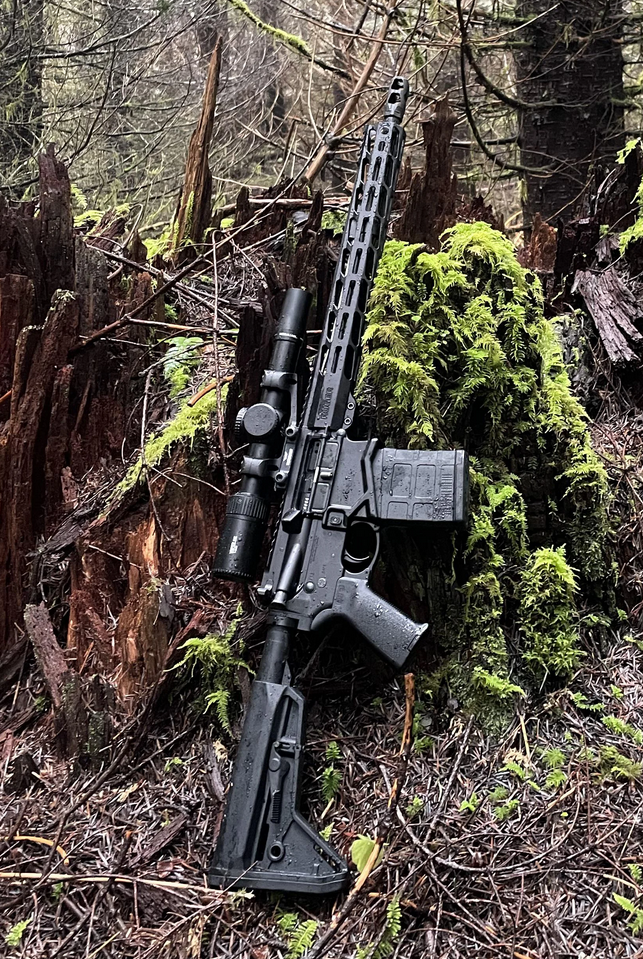
It's also ideal for shooters who want one rifle that handles both precision work and general shooting duties. The accuracy is sufficient for hunting out to 400-500 yards, while the weight makes it practical for extended range sessions.
The SFAR works well for users who already have AR-15 experience and want to move up to .308 without learning an entirely new platform. The controls and manual of arms are identical to what you already know.
What to test first
Start with quality brass-cased ammunition in 168-grain weight. Federal Gold Medal Match and Hornady ELD Match both perform well and establish your accuracy baseline. Avoid steel case for the first 100 rounds while the rifle breaks in.
Zero at 100 yards and confirm your scope mounting before moving to longer ranges. The SFAR holds zero well, but proper scope installation is critical for any precision work.
Test magazine seating with your chosen magazines. Make sure they lock in firmly and drop free when released. This prevents feeding issues during critical moments.
Run a function check with your preferred ammunition to confirm proper cycling. Adjust the gas block if needed, but most rifles run fine on the factory setting with quality ammo.
The SFAR delivers on its promise of .308 performance in a lightweight package. You're not giving up accuracy or reliability for the weight savings, just some parts compatibility and upgrade options compared to traditional AR-10s. For hunters and shooters who prioritize portability without sacrificing .308 capability, it's a solid choice that performs as advertised.