You're standing at the counter or scrolling through an online retailer, and there are eight different boxes of 9mm FMJ all priced somewhere between $12 and $18. They all say 115 grain, they all say brass case (mostly), and they all promise reliable performance. So which one do you actually grab?

The price spread across mainstream 9mm training loads is tighter than most people think. We're talking a few dollars per box, which translates to maybe $40-$80 difference across a 1,000-round case. But those small differences compound if you're shooting 500 rounds a month, and the stuff that matters beyond price (velocity consistency, case quality for reloaders, how dirty it runs) varies more than you'd expect between brands at the same shelf price. This breakdown covers the loads that actually land under that $18-per-box threshold at typical retail, ranked by the combination of reliability, value, and real-world track record that matters for regular training use.
Quick picks
- CCI Blazer Brass 9mm 115gr FMJ — Best overall
- PMC Bronze 9mm 115gr FMJ — Best budget brass
- Magtech 9mm 115gr FMJ — Best for reloaders
- Sellier & Bellot 9mm 115gr FMJ — Best European import
- Fiocchi 9mm 115gr FMJ — Best accuracy for training
- CCI Blazer Aluminum 9mm 115gr FMJ — Best rock-bottom price
- Norma 9mm 115gr FMJ — Best newcomer value
At a glance
How we chose
Every load on this list had to meet a straightforward set of criteria. First, the 50-round box price needed to come in under $18 at commonly available retail or online pricing based on current source data. Second, the load needed to be brass-cased or aluminum-cased with Boxer primers and non-corrosive propellant, meaning it'll run in any modern 9mm without concerns about corrosion or range restrictions on steel cores. Third, we looked at the manufacturer's track record for consistency and the volume of real-world feedback from shooters who run these loads regularly.
Reliability across platforms matters more than anything else for training ammo. A load that causes one malfunction per 200 rounds isn't saving you money; it's costing you time and building bad habits. Every pick here has a documented history of feeding reliably across compact carry guns, full-size duty pistols, and everything in between. We also weighted brass quality for shooters who reload, since the cost math on 9mm training ammo changes dramatically if you're picking up your brass.
Manufacturer support and availability factored in heavily. A load that's perpetually out of stock or only available from a single retailer doesn't help you maintain a consistent training schedule. All seven picks are produced by manufacturers with established distribution networks and consistent production runs.
The picks
CCI Blazer Brass 9mm 115gr FMJ
Best for: overall training value and reliability across all 9mm platforms
CCI Blazer Brass 9mm 115gr FMJ Deals
Prices may change. May contain affiliate links.
Federal American Eagle 9mm Deals
Prices may change. May contain affiliate links.
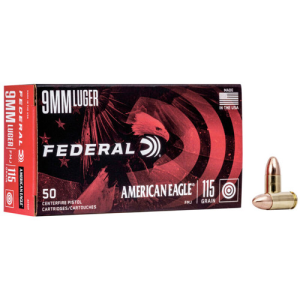
Blazer Brass has earned the top spot in most 9mm range ammo rankings for 2026, and the reason is simple: it does everything well enough that there's no compelling reason to pay more for basic training. The 115-grain FMJ loaded to 1,145 fps from a 4-inch barrel puts it right in the middle of the velocity range for this bullet weight, generating 335 ft-lbs of muzzle energy. That's close enough to most carry ammo ballistics that your recoil impulse during practice will translate meaningfully to defensive shooting.

The brass cases are reloadable with standard Boxer primers, and CCI's quality control on case dimensions tends to be consistent enough that reloaders report good results through multiple loadings. The protected-base bullet construction reduces fouling compared to some competitors, which means slightly less cleaning time during extended sessions. In bulk pricing, Blazer Brass consistently lands at the lower end of the brass-cased 9mm spectrum, typically running $0.23-0.27 per round in 1,000-round cases according to 2026 pricing data.
What the marketing doesn't mention: Blazer Brass isn't the most accurate load on this list, and it won't win any precision competitions. But for draw-and-fire drills, plate racks, and general marksmanship maintenance, the accuracy is more than adequate. The value proposition is hard to beat.
Pros
- Consistently among the lowest-priced brass-cased 9mm loads in bulk
- Protected-base bullet design reduces barrel fouling
- Reloadable brass with Boxer primers
- Extremely wide availability across online and brick-and-mortar retailers
- Strong reliability track record across compact and full-size 9mm pistols
Cons
- Not the most accurate option for precision-focused training
- Velocity of 1,145 fps is slightly lower than some competitors at 115 grain
- Occasional reports of slightly dirtier powder residue than Federal American Eagle

PMC Bronze 9mm 115gr FMJ
Best for: budget-conscious shooters who want clean brass cases

PMC Bronze 9mm 115gr FMJ Deals
Prices may change. May contain affiliate links.

Winchester White Box 9mm Deals
Prices may change. May contain affiliate links.
PMC Bronze is manufactured in South Korea and has been a staple of the American training ammo market for years. The 115-grain FMJ is loaded to 1,150 fps with 338 ft-lbs of muzzle energy at the muzzle, putting it in a nearly identical performance envelope to Blazer Brass. PMC publishes full ballistic data including trajectory: at 50 yards you're looking at a zero, dropping to -2.59 inches at 75 yards and -7.26 inches at 100 yards from a 50-yard zero.
The brass cases use Boxer primers and are reloadable. PMC's brass tends to have consistent wall thickness, which reloaders appreciate. The load is packaged in standard 50-round boxes and 1,000-round cases of 20 boxes each. Pricing in bulk puts PMC Bronze firmly in the budget tier alongside Blazer Brass, and it's one of the loads that routinely shows up at the lowest per-round cost on ammo aggregator sites.
Shooter feedback consistently describes PMC Bronze as clean-running and reliable. It doesn't generate the volume of complaints about dirty powder that Winchester White Box or some other domestic loads attract. For pure range work where you're burning through 200-300 rounds per session, PMC Bronze is one of the most cost-effective ways to do it.
Pros
- Competitive bulk pricing, consistently among the cheapest brass-cased options
- Published ballistic data including trajectory for shooters who want to verify at distance
- Clean-burning relative to several domestic competitors
- Reloadable brass with consistent dimensions
- Broad availability in both box and case quantities
Cons
- Imported from South Korea, so availability can fluctuate with shipping logistics
- 338 ft-lbs muzzle energy is slightly below some competitors at this bullet weight
- Less name recognition than Federal or Winchester for shooters who care about that

Magtech 9mm 115gr FMJ
Best for: reloaders and high-volume shooters who want quality brass at a low price
Magtech 9mm 115gr FMJ Deals
Prices may change. May contain affiliate links.

Magtech 9mm 115gr FMJ Steel Case 9AS Deals
Prices may change. May contain affiliate links.
Magtech is a Brazilian manufacturer that's been producing ammunition since the 1920s, and their 9mm 115-grain FMJ (model MP9A) is one of the most popular training loads worldwide. The numbers: 1,135 fps muzzle velocity, 329 ft-lbs of energy, tested from a 4-inch barrel. The ballistic coefficient is .144 (G1), which is standard for a 115-grain 9mm FMJ. At 50 yards you're looking at a 1.9-inch drop, extending to 11.8 inches at 100 yards.
The brass cases are the real story here. Magtech's brass is well-regarded among reloaders for consistent weight and dimensional uniformity. The cases use Boxer primers, are non-corrosive, and the load runs at standard pressure (not +P). For shooters who reload, the per-round cost of Magtech drops even further on subsequent loadings because the brass holds up well.
Magtech also produces a steel-cased version (model 9AS) at 1,135 fps with a .144 BC, which drops the per-round cost even further but sacrifices reloadability. The steel-case version runs around $0.22 per round at retail, though some indoor ranges prohibit steel cases. The brass version is the better long-term value for anyone who picks up their brass.

Pros
- Excellent brass quality with consistent dimensions for reloading
- Published ballistic coefficient (.144 G1) and trajectory data
- Standard pressure loading compatible with all 9mm platforms
- Non-magnetic bullet construction won't trigger range restrictions
- Available in both 50-round boxes and 1,000-round cases
Cons
- 1,135 fps is the slowest velocity on this list, producing the lowest muzzle energy
- Imported from Brazil, occasional availability gaps
- Slightly less available at big-box retailers compared to domestic brands
Sellier & Bellot 9mm 115gr FMJ
Best for: shooters who want European manufacturing quality at domestic prices

Sellier & Bellot 9mm 115gr FMJ Deals
Prices may change. May contain affiliate links.
Sellier & Bellot has been making ammunition since 1825 in what is now the Czech Republic. That's not marketing fluff; it's relevant because their quality control processes are deeply established. The 9mm 115-grain FMJ (model SB9A) is a brass-cased, Boxer-primed load that's been a favorite among competitive shooters and regular range users for years. S&B ammo is widely described as excellent for practice, recreational shooting, and competitive handgun use.

S&B can be found in the $0.24-0.27 per round range based on recent retailer pricing, which places it squarely in the budget tier alongside Blazer Brass and PMC Bronze. The consistency of S&B's manufacturing is where it earns its reputation. Shooters who track their groups tend to find S&B produces tighter patterns than some domestic budget loads, though the margin narrows as you move to higher-priced American-made options.
The 50-round boxes are compact and well-packaged, and the brass is popular among reloaders. S&B brass tends to be slightly harder than some domestic brands, which can mean longer case life but may require a bit more effort in resizing.
Pros
- Nearly 200 years of manufacturing heritage with established quality control
- Competitive bulk pricing in the budget brass-cased tier
- Reputation for consistency and above-average accuracy in its price class
- Popular brass among reloaders for its durability
- Well-distributed across major online ammo retailers
Cons
- Muzzle velocity and energy specifications not published in available sources for this specific load
- Imported, so supply can be affected by international shipping disruptions
- Harder brass may require adjustment to reloading dies for some setups

Fiocchi 9mm 115gr FMJ
Best for: accuracy-focused training and competition practice
Fiocchi 9mm 115gr FMJ Deals
Prices may change. May contain affiliate links.
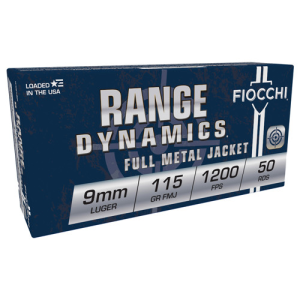
Fiocchi stands out on this list for one specific reason: velocity. The 115-grain FMJ is loaded to 1,200 fps, which is the highest muzzle velocity among the picks here, generating 368 ft-lbs of muzzle energy. That's a meaningful step up from loads running 1,135-1,150 fps, and it translates to a slightly snappier recoil impulse that some shooters prefer for competition practice where they want to train with a load that feels closer to major power factor.
Fiocchi has its roots in Italy, founded in 1872, with manufacturing now split between Italy, the U.S., Great Britain, and Hungary. The 9mm 115-grain FMJ (model 9AP) uses brass cases with Boxer primers, is non-corrosive, and is fully reloadable. It's packaged in 50-round boxes and 1,000-round cases. Source rankings for 2026 describe Fiocchi as having the best accuracy among budget 9mm loads, which tracks with its higher velocity and the generally tight tolerances Fiocchi maintains.
The trade-off is price. Fiocchi typically runs a notch above the cheapest options, landing in the mid-tier for per-round cost. The accuracy advantage is real but matters most for shooters who are actually working on precision at 15-25 yards, not just burning through magazine dumps at 7 yards.
Pros
- Highest muzzle velocity (1,200 fps) and energy (368 ft-lbs) among picks
- Ranked as best accuracy among budget 9mm loads in 2026 testing
- Reloadable brass with Boxer primers
- Non-corrosive propellant
- Available in both box and case quantities
Cons
- Slightly higher per-round cost than the budget tier picks
- Higher velocity means marginally more felt recoil than 1,135-1,145 fps loads
- Stock availability can be inconsistent at some retailers

CCI Blazer Aluminum 9mm 115gr FMJ
Best for: absolute lowest cost per round when reloading isn't a factor
CCI Blazer Aluminum 9mm 115gr FMJ Deals
Prices may change. May contain affiliate links.
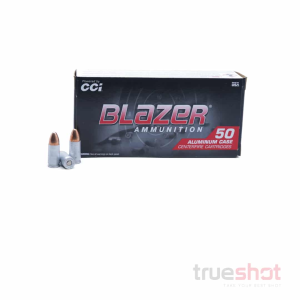
Here's where it gets interesting for the pure cost-per-round optimizer. CCI Blazer Aluminum uses heat-treated, aircraft-grade aluminum cases instead of brass, and that material savings gets passed directly to the shooter. The ballistics are identical to Blazer Brass: 115-grain FMJ at 1,145 fps with 335 ft-lbs of muzzle energy. Same bullets, same primers, same powder charge. The only difference is the case you're leaving on the ground.
In 2026, Blazer Aluminum runs $0.20-0.24 per round in bulk, consistently the cheapest reliable 9mm range ammo available. The aluminum cases are not reloadable, which is the obvious trade-off. If you don't reload and never plan to, there's no practical downside. The cases are recyclable like aluminum cans, and you don't have to spend time policing your brass.
The one caveat: some indoor ranges prohibit aluminum-cased ammo, though this is less common than steel-case restrictions. Check your range's rules before buying a case. For outdoor range use or ranges that allow it, Blazer Aluminum is the most efficient way to put rounds downrange.
Pros
- Lowest per-round cost of any reliable 9mm training load ($0.20-0.24/rd in bulk)
- Identical ballistics to Blazer Brass (1,145 fps, 335 ft-lbs)
- Heat-treated aircraft-grade aluminum cases
- Quality CCI primers and bullets
- No need to police brass after shooting
Cons
- Not reloadable, eliminating long-term cost savings for handloaders
- Some indoor ranges prohibit aluminum cases
- Aluminum cases can't be resold to brass recyclers for any meaningful return
Norma 9mm 115gr FMJ
Best for: shooters who want a newer domestic-manufactured option with strong ballistics

Norma's Range & Training 9mm line is now loaded at their Georgia facility in the U.S., which addresses the import availability concerns that used to affect this brand. The 115-grain FMJ runs at 1,214 fps with 379 ft-lbs of muzzle energy from brass cases with Boxer primers. One retailer lists the muzzle energy slightly lower at 378 ft-lbs, suggesting minor rounding differences between sources. Either way, Norma sits near the top of the velocity range for 115-grain loads, trailing only Fiocchi.
The brass is reloadable, and Norma's reputation in the precision rifle world carries over to their pistol ammunition in terms of quality control. The load is packaged in 50-round boxes and 1,000-round cases of 20 boxes. Norma's 9mm training ammo is relatively newer to the U.S. market compared to legacy brands like Federal or Winchester, but shooter reviews consistently describe it as clean-running with no feeding issues.
The cost math on Norma puts it in the mid-tier, roughly comparable to Fiocchi. For shooters who want U.S.-manufactured ammo with European engineering heritage, Norma fills that niche well.
Pros
- Now manufactured domestically in Georgia, reducing supply chain concerns
- Strong muzzle velocity (1,180 fps) and energy (356 ft-lbs) for 115-grain
- Reloadable brass with Boxer primers
- Clean-running with positive shooter feedback on reliability
- Norma's precision manufacturing reputation
Cons
- Newer to the U.S. training ammo market with less long-term track record than legacy brands
- Mid-tier pricing, not the cheapest option
- Some velocity variation reported between sources, suggesting less consistency data is available

Chrono notes
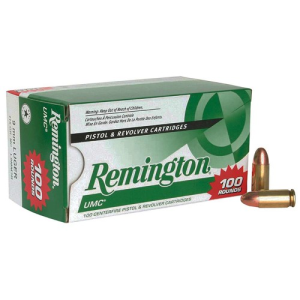
The velocity spread across these seven loads tells you something useful. At the bottom, Magtech sits at 1,135 fps. At the top, Fiocchi hits 1,200 fps. That 65 fps difference translates to about 40 ft-lbs of energy at the muzzle, which you'll feel as a slight difference in recoil snap but won't meaningfully change your point of impact at typical training distances under 25 yards. Where it does matter is if you're trying to match the feel of your carry ammo. Most 115-grain defensive loads run in the 1,150-1,210 fps range, so Fiocchi and Norma will feel closest to defensive ammunition. Blazer Brass, PMC Bronze, and Remington UMC cluster around 1,145-1,150 fps, which is a perfectly adequate match for most carry loads.
Remington UMC 9mm Deals
Prices may change. May contain affiliate links.
Common mistakes with training ammo
Buying by brand loyalty instead of by the numbers is the most common error. A shooter who's always bought Winchester because their dad did might be paying $2-3 more per box than they need to for equivalent performance. Run the per-round math across a year of training and that adds up fast.
Ignoring range restrictions before buying in bulk is an expensive lesson. Some indoor ranges ban aluminum cases, and a surprising number ban steel cases entirely. If you shoot at an indoor facility, confirm their policy before ordering a 1,000-round case of Blazer Aluminum.
Not testing your specific gun with a new load before committing to a case purchase is a mistake that costs more than the single box you should have started with. Most 9mm loads run fine in most guns, but compact pistols with tight tolerances can be pickier. Buy one box, run 50 rounds, then order the case.
Storing ammo improperly degrades performance over time. All of these loads use non-corrosive Boxer primers, but humidity and temperature swings still affect powder consistency. A cool, dry storage location keeps your training ammo performing to spec for years.
Overlooking the reloading equation is leaving money on the table if you have any interest in handloading. The difference between Blazer Aluminum at $0.20/rd and Blazer Brass at $0.23/rd disappears entirely if you reload that brass even once. Over multiple reloads, the brass-cased option becomes dramatically cheaper per trigger pull.
How to choose
Match your training ammo velocity to your carry ammo. If you carry 115-grain defensive loads, any of these picks will feel similar. If you carry 124 or 147-grain loads, the recoil impulse will differ regardless, but staying in the 1,145-1,180 fps range keeps the general feel in the right neighborhood.
If you reload, eliminate Blazer Aluminum immediately and focus on Magtech, PMC Bronze, or S&B for brass quality. If you don't reload and never will, Blazer Aluminum is the clear cost winner with no performance penalty.
For accuracy-focused training where you're actually working on group sizes at 15-25 yards, Fiocchi's higher velocity and documented accuracy edge justify the slight price premium. For draw-and-fire drills, plate racks, and general round count, the cheapest reliable option (Blazer Brass or PMC Bronze) is the right call.
Availability should factor into your decision more than most shooters realize. The load you can consistently find and buy is worth more than the theoretically perfect load that's perpetually out of stock. Blazer Brass, Federal American Eagle, and Winchester White Box have the broadest retail distribution. PMC, Magtech, and S&B are well-stocked online but can be harder to find on local shelves.
If your range bans aluminum cases, that eliminates Blazer Aluminum. If your range bans steel cases, avoid Magtech's steel-cased variant (9AS) but the standard brass Magtech (9A) is fine.
Next steps
Buy one box of your top two picks and shoot them back to back in the same range session. Pay attention to three things: how the recoil compares to your carry ammo, whether you notice any difference in how dirty each load runs, and whether either one causes any feeding issues in your specific gun. If you're a reloader, save the brass from both and inspect it after firing for case mouth splits, primer pocket looseness, or any deformation that would affect reloading.
Once you've confirmed reliable function, order in bulk. The per-round savings between a 50-round box and a 1,000-round case typically run $0.03-0.06 per round, which means you're saving $30-60 per case. At 500 rounds a month, that's $180-360 a year just from buying smart. Set a price alert on an ammo aggregator site for your chosen load and buy when it dips below the 90-day average. The 9mm market fluctuates enough that patience on timing can save another 10-15% on top of the bulk discount.