
You found an old bolt-action rifle at a gun show. The receiver is marked "I.G. Mod. 71." in Gothic script, there's a monarch's cypher on the left chamber flat, and the bore diameter is stamped right there on the metal: 11.0mm. The seller says it's "all original." Before you hand over cash, you need to know what you're actually looking at, because the Model 1871 is where the Mauser story starts, and the details that separate a correct example from a parts gun or a refinished fake are specific, documented, and worth understanding.
Infanterie-Gewehr Model 1871
May contain affiliate links.
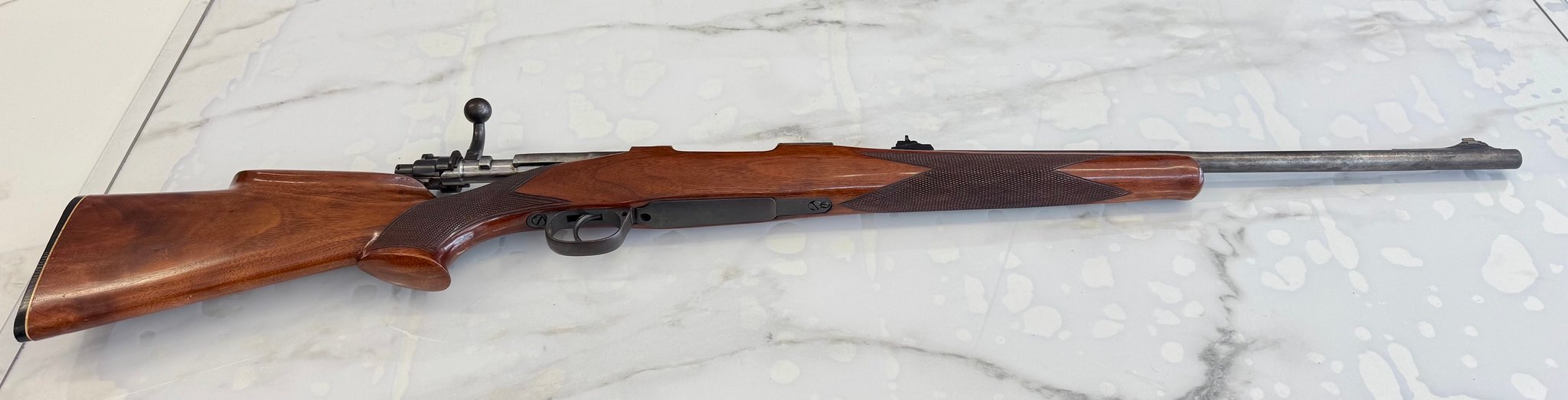
The Gewehr 71, formally adopted as the Infanterie-Gewehr Model 1871, was the first rifle to carry the Mauser name into military service. Every bolt-action Mauser that followed, from the 71/84 repeater through the Gewehr 98 and the K98k, descends from this single-shot black powder rifle. Collecting here means collecting at the root of the tree. But it also means dealing with rifles that are over 150 years old, produced across multiple arsenals, issued to units across the German Empire and beyond, and sometimes reassembled from mismatched parts over the intervening century and a half. The distinctions matter. Here's how to read them.

Why the Model 1871 matters
The Model 1871 wasn't just another military rifle. It was the gun that transformed Paul and Wilhelm Mauser from independent designers into recognized military-arms manufacturers. Before the 1871, the brothers were tinkering with breechloading designs, working in association with Samuel Norris, the Remington importer for Europe, on a bolt-action single-shot rifle for metallic cartridges as early as 1867. After the 1871, they had a factory, a government contract, and a name that would define bolt-action rifle design for the next eight decades.
The German Empire's adoption of the design in 1871, with formal acceptance on 14 February 1872 after safety revisions were completed with support from the government's Spandau arsenal, unified infantry armament across the German states. Bavaria was the exception, retaining its Werder rifle until later integration. But for the newly unified German Empire, the Gewehr 71 was the standard. Approximately 1.82 million rifles and Jägerbüchse and 80,000 to 100,000 carbines were produced. That's a substantial production run, and it means surviving examples do turn up. The question is always condition and correctness.
For collectors, the Model 1871's significance is foundational. The Model 1871 established the business. The later Model 1893 advanced the repeating-rifle system. The Gewehr 98 completed the classic action. The Karabiner 98k adapted it for another generation of military service. You can't understand the lineage without understanding where it began. And you can't evaluate a specimen without understanding the specific markings, configurations, and variants that were produced.
The development story
Paul Mauser developed his bolt-action rifle from 1867 to 1871. The action was not based on its predecessor, the Dreyse needle gun, but its own engineering was innovative and represented one of the first successful metallic cartridge bolt-action rifles. The shift from needle-fire to metallic cartridge firearms was the technological leap of the era, and the Mauser brothers were positioned at exactly the right moment.

The partnership with Norris gave the Mausers access to resources and connections, but the design genius was Paul Mauser's. He systematically developed his basic design over an extended period, and almost every good original feature of the metallic cartridge turning bolt-action rifle design can be traced to his work. The Gewehr 71 is a conventional-looking bolt action chambered in 11mm using black powder cartridges. The action included only a bolt guide rib as its single locking lug, locking forward of the receiving bridge. The original design was a single-shot, which was standard practice for military rifles of the period. Repeating mechanisms were still viewed with suspicion by most ordnance boards, who worried about soldiers wasting ammunition.
The safety mechanism required revision before formal adoption, and this is where the Spandau arsenal's involvement became critical. With government support, the improvements were completed and the rifle was accepted. Wilhelm and Paul Mauser's firm was not listed in the Oberndorf trade register until December 23, 1872, meaning the rifle was actually adopted before the company was even entered in the register. That's a detail worth knowing: the design preceded the factory.
The original 11x60mmR Mauser cartridge, also known as the .43 Mauser, was a black powder round with a rimmed case 60mm long and a bullet diameter of approximately 11mm. The original military load launched paper-patched bullets of 0.446-inch diameter and 370 grains weight using 88 grains of black powder to generate 1,430 feet per second. That far outclassed various military cartridges then standardized and many that would follow. The iron sights were graduated from 200 to 1,600 meters, which was the maximum setting. Whether anyone was hitting targets at 1,600 meters with black powder and iron sights is another question entirely, but the optimism of 19th-century ordnance boards was boundless.

Service use and cultural moments
The rifles were issued to the German Army from late 1873 to 1875, arming the infantry of the newly unified empire. The Gewehr 71 saw service across the conflicts of the late 19th century and, in various hands, well into the 20th. Askari troops in German East Africa were armed with Model 1871s, and the rifle appeared in colonial service long after it had been superseded in European units.

The 71/84 variant, adopted in 1884, became the German Army's first repeating rifle, and it saw action in a remarkable range of conflicts. The list includes the Argentine Civil Wars, the Greco-Turkish War of 1897, the Uruguayan Revolution of 1897, the Second Boer War, the Boxer Rebellion, the Balkan Wars, World War I, the German Revolution of 1918-19, and even limited use in World War II. That's a service life spanning from the age of black powder to the age of the atomic bomb, though by the later conflicts these rifles were relegated to rear-echelon, training, or desperation roles.
The Model 1871's broader cultural significance lies in what it launched. The large Turkish contract of 1887, for 500,000 rifles and 50,000 carbines, helped establish Mauser as a leading small arms manufacturer. Elements of the Mauser M71 bolt would go on to be utilized in the 8mm Portuguese M1886 Mauser-Kropatschek, which combined them with Kropatschek's tubular magazine system, and dozens of smokeless powder Mauser military rifles followed from the end of the 19th century through the middle of the 20th. The 1871 was the proof of concept that made all of that possible.
There's also the bayonet connection. The knife bayonet became general issue in a major army for the first time when Germany redesigned the single-shot Mauser M1871 rifle into a repeating rifle in 1884. The M1871/84 knife bayonet profile persisted through subsequent patterns, and a modification of the old M1871/84 knife bayonet was introduced alongside the M1898/05 "Butcher Blade" bayonet for the Gewehr 98. Bayonet collectors and rifle collectors intersect heavily here, and a correct bayonet adds significantly to the completeness of any 71 or 71/84 display.

Even Siam acquired M1871 Mausers, with at least one native-made example documented in collector circles. Uruguay adopted a converted version, the M1871/94 Daudeteau, which rechambered the old rifles for a different cartridge. Serbia adopted a more up-to-date version in 1881, the M1878/80, still single-shot but chambered in its own 10.15x63R caliber. The 1871 platform traveled far beyond German borders, and export and foreign-contract variants add complexity to any collection.
Variants and key differences
The distinction between a Model 71, a Model 71/84, and later national conversions is essential. Manufacturer, arsenal, date, chambering, stock configuration, and unit markings must be evaluated together. Here are the major variants a collector will encounter.
Infanterie-Gewehr M1871
The standard infantry rifle. Single-shot, chambered in 11x60mmR. The left rear of the receiver is marked "I.G. Mod. 71." in Gothic script. There's a monarch's cypher on the upper left chamber flat, and multiple parts such as the flat of the bolt handle carry proof marks. These could be F.W. (Friedrich Wilhelm of Prussia), Crown over L, or other state marks depending on the issuing authority. The trigger guard is almost always brass, though examples with steel trigger guards exist and the reason for the variation isn't fully documented. The bore diameter is typically stamped on the left chamber flat just ahead of the receiver, generally anywhere from 10.95 to 11.05mm. The right forward chamber flats are usually profusely marked with German proof testing marks. Production was centered at Spandau arsenal, with other facilities contributing.
Jägerbüchse M1871 (hunter short rifle)
Adopted on 18 January 1876, this was a shortened and lightened M71 developed for the Jäger or light infantry. It also served with engineers, fortress, and navy units. The configuration is somewhat similar to the infantry rifle but reduced in length and weight. These are less commonly encountered than the full-length infantry rifles and tend to command more collector interest as a result.
May contain affiliate links.

M1871 carbine
A cavalry carbine variant, further shortened for mounted troops. With only 80,000 to 100,000 carbines produced against 1.82 million rifles and Jägerbüchse, these are genuinely scarce. A period-correct, all-original carbine in collector grade is a significant find.
May contain affiliate links.
Gewehr 71/84
The repeating variant, adopted in 1884. This incorporated an 8-round tubular magazine designed by Alfred von Kropatschek, housed beneath the barrel. The magazine was loaded through the breech, unlike the original Swiss Vetterli M1869, which had a loading gate on the receiver side (though this was removed with the M1869/71 update in 1871). The 71/84 retained the Mauser bolt and safety design of the earlier M1871 and added a magazine cut-off that allowed the rifle to be used as a single-shot, leaving the ammunition in the magazine for use when rapid fire was essential. The rifle weighed about 10 pounds. The receiver is marked "I.G. Mod. 71/84." Production occurred at both Spandau and Danzig arsenals, among others. Danzig-made rifles are not often encountered and almost never found in high states of preservation, making them particularly desirable. A prototype of an M1871 with a tubular magazine was displayed to Wilhelm II as early as September 1881, but troop trials in 1882 and 1883 preceded the formal 1884 adoption.
May contain affiliate links.

The 71/84 Jäger variant had the same configuration as the standard infantry rifle with the addition of a sling swivel at the butt.
Ottoman M1887
Adopted by the Ottoman Empire, this differed from the M71/84 in several ways: a side-mounted cleaning rod, only two barrel bands, a second locking lug on the rear of the bolt, and chambering in 9.5x60mmR, which Paul Mauser touted as the most efficient black powder cartridge. The large Turkish contract for 500,000 rifles was a landmark moment for the Mauser company.
May contain affiliate links.
Serbian M1878/80
A more up-to-date single-shot version chambered in 10.15x63R. This represents one of the early export adaptations of the basic Mauser design for a foreign military.
May contain affiliate links.
Uruguayan M1871/94 Daudeteau conversion
Uruguay converted its M1871 rifles with the Daudeteau system, rechambering them. These converted rifles are documented in period photographs of Uruguayan soldiers and represent a distinct collecting niche.
Uruguayan M1871/94 Daudeteau
May contain affiliate links.
Mauser-Koka M80/07
A later conversion of the basic platform that used a 5-round stripper clip and internal magazine, moving away from the single-shot configuration entirely. This represents the end-of-life modernization attempts for the 1871 platform.
May contain affiliate links.
Collector notes
What to look for
A correct M1871 should have consistent markings throughout. The Gothic script "I.G. Mod. 71." on the left rear receiver is the starting point. Check the monarch's cypher on the upper left chamber flat. Multiple parts, including the flat of the bolt handle, should carry matching proof marks. The bore diameter stamp on the left chamber flat, generally between 10.95 and 11.05mm, should be present and legible. The right forward chamber flats should show profuse German proof testing marks.

On the 71/84, look for unit markings. These can dramatically increase collector interest. One documented example from Danzig bears WWI unit marks indicating Company "E," 2nd Battalion, with a specific gun number. Unit markings to the First World War make any 71/84 more desirable and a better addition to a serious German military rifle collection.
Manufacturer, arsenal, date, chambering, stock configuration, and unit markings must be evaluated together. A rifle where all of these elements agree is what you want. A rifle where the barrel says one thing and the stock says another is a parts gun, regardless of what the seller claims.
Red flags most buyers miss
The first trap is assuming "old" means "original." These rifles have been through 150 years of arsenal service, unit transfers, colonial deployment, foreign sales, and private ownership. Parts got swapped. Stocks got replaced. Metal got refinished. Here's what to watch for:
Mismatched serial numbers across major components are the most obvious warning sign. On a correct example, the bolt, receiver, and other serialized parts should agree. If they don't, you're looking at a rifle that was reassembled from available parts at some point in its life. That's not necessarily a disqualifying flaw for a shooter, but it matters enormously for collector value.

Reblued finishes are common on rifles of this age that look suspiciously good. A 71/84 retaining 93% of its original brilliant blued finish is genuinely exceptional and commands a premium. A rifle that looks like it has 93% finish because someone dunked it in a cold blue tank is worth a fraction of that. Look for the telltale signs: blue pooling in markings, softened edges on proof marks, and an unnaturally uniform color that doesn't match the wear patterns you'd expect from actual use. Reblued finishes lose 40-60% of collector value.
Replacement stocks are another issue. The wood should show appropriate age, correct cartouches and inspector marks for the period, and wear patterns consistent with the metal. A brand-new stock on 150-year-old metalwork is obvious if you're looking for it.
Conversions and modifications can be subtle. Some M1871s were converted to different chamberings by foreign purchasers. The Uruguayan Daudeteau conversion is documented, but other less well-known modifications exist. If the chambering doesn't match what the receiver markings indicate, investigate before buying.
The brass trigger guard is nearly universal on the M1871, but steel trigger guards do exist on some examples. This isn't necessarily a red flag, but it's an anomaly worth researching for the specific rifle in question.
Arsenal and manufacturer identification
Spandau arsenal was the primary production facility, but Danzig also produced rifles, particularly the 71/84. Prussian guns from Spandau tend to be found in wonderful condition from time to time, but Danzig-made rifles are not often encountered and almost never in high states of preservation. That rarity differential matters. An excellent Danzig 71/84 is a harder find than an excellent Spandau example, and the market reflects that.

The Mauser factory at Oberndorf was involved in production as well, and contract rifles for foreign governments may carry different manufacturer markings entirely. Ottoman M1887 rifles, for instance, would show Mauser factory markings rather than Prussian arsenal stamps.
Condition and value factors
Condition means different things here than it does for a World War II K98k. You're evaluating a rifle from the 1870s and 1880s. Perfect preservation is extraordinarily rare, and the grading scale shifts accordingly.
An "excellent" 71/84, like the documented Danzig example with WWI unit marks, retains about 93% or more of its original brilliant blued finish on the barrel, with only minor fading and small patches of lightly oxidized freckling mixed with the blue. A crisp bore adds to both collector and shooting value. That level of preservation would be very difficult to improve upon without spending significantly more money.
For the M1871 single-shot rifles, similar standards apply but the baseline expectation for condition is generally lower. These rifles are older, were produced in larger numbers, and have had more time to accumulate wear, damage, and amateur refinishing. A rifle with honest wear, matching numbers, correct markings, and a decent bore is a solid find even if it doesn't look like it came out of the arsenal yesterday.
Features that add value include matching serial numbers across all major components, documented unit markings (especially to specific conflicts), correct original finish, an unmodified stock with legible cartouches, and the presence of correct accessories like bayonets and cleaning rods. The Jägerbüchse and carbine variants command premiums over the standard infantry rifle due to lower production numbers. Danzig-made 71/84s are worth more than equivalent Spandau examples simply because they're harder to find.

Features that subtract value include mismatched parts, reblued or refinished metal, replaced stocks, import marks (though these are less common on rifles this old than on later surplus), damaged or corroded bores, and modifications or conversions that weren't performed by a military arsenal. A "put-together" rifle assembled from parts bins might look complete at first glance, but it won't hold up under scrutiny and won't hold value in a serious collection.
One Spandau 71/84 listed as "period correct and all original, collector grade, unissued" was priced at $1,700 at a dealer. That gives you a reference point for what an exceptional example commands, though the market varies by region, venue, and the specific details of each rifle. These rifles qualify as antiques under U.S. law, manufactured before 1899, which means they can generally be bought and sold without the same federal firearms license requirements as modern guns. That's a practical advantage for collectors, but verify the specifics with current law in your jurisdiction.
Shooting experience today
The Gewehr 71 and 71/84 are shootable rifles, and the 11x60mmR cartridge is capable of impressive performance. The original military load's 386-grain paper-patched bullet at 1,430 fps is substantial, and documented testing with loads duplicating the original military specification shows impressive long-range accuracy. Hits on the official Friends of Billy Dixon target, composed of silhouettes of three riders on horseback, have been made using 71/84 rifles with appropriate loads.
The practical challenge is ammunition. The 11x60mmR Mauser is not a cartridge you'll find on the shelf at your local sporting goods store. Reloading is essentially the only option for sustained shooting. Lee Precision manufactures dies for the cartridge, listed under the .43 Mauser designation. Handloading for these rifles requires care and attention to pressure limits. Original black powder loads probably generated about 25,000 psi, and it seems prudent to keep modern loads used in original rifles to that pressure level or below. Using heavier bullets with smokeless powder loaded to duplicate what black powder would do, at entirely safe pressures, is a viable approach that has been demonstrated successfully.
The single-shot M1871 has a straightforward manual of arms: open the bolt, insert a cartridge, close the bolt, fire. The 71/84's tubular magazine adds complexity. The magazine was loaded through the breech, and the cut-off mechanism allowed switching between single-shot and magazine-fed operation. The mechanical interaction is interesting from a historical standpoint and gives you a tangible sense of how infantry doctrine evolved. The rifle weighs about 10 pounds in the 71/84 configuration, which is hefty by modern standards but was typical for the era.
The bolt action itself is the ancestor of everything that followed. It's not as smooth or refined as a Gewehr 98 action, but it's robust and functional. The single locking lug, consisting of the bolt guide rib locking forward of the receiving bridge, is a simpler arrangement than the dual-lug system Paul Mauser would later develop. It works, but it's a reminder that this was the first generation of the design.
One safety note: these are 150-year-old rifles. Before shooting any original M1871 or 71/84, have the headspace checked and the bore inspected by someone who knows what they're looking at. A crisp bore with strong rifling is a good sign. A dark, pitted bore with questionable rifling is a reason to keep the rifle on the wall rather than at the range. The Mauser action proved more robust than some contemporaries in adverse conditions, such as mud, where competitors like the Vetterli's complex magazine was prone to jamming. But age is the enemy of all mechanical devices, and caution is warranted.

Care, storage, and parts availability
Maintaining a collector-grade M1871 or 71/84 without harming its value requires restraint. The cardinal rule: do not refinish anything. Don't reblue the metal. Don't sand the stock. Don't replace parts with reproductions unless you're building a shooter and have no interest in collector value. Every "improvement" you make to the cosmetics of an original rifle subtracts from its authenticity and its worth.
For storage, standard practices apply. A climate-controlled environment with stable humidity is ideal. These rifles have brass trigger guards and steel components that react differently to moisture, so inconsistent conditions can cause problems over time. A light coat of quality gun oil on metal surfaces prevents rust without leaving heavy residue that could damage wood.
Cleaning after shooting requires attention to the black powder residue issue. If you're shooting black powder loads or black powder substitutes, clean promptly and thoroughly. Black powder residue is hygroscopic and corrosive if left in the bore. Hot soapy water followed by thorough drying and oiling is the traditional approach and still works.
Parts availability is limited. You're not going to find a shelf of M1871 replacement bolts at your local gun shop. Parts guns, other collectors, and specialty dealers are your sources. The good news is that over 1.82 million rifles were produced, so parts do circulate. The bad news is that finding the correct part for a specific arsenal and date range can be a lengthy search. For the 71/84, over a million were produced, so the situation is similar.
Specialist gunsmiths who work on antique military rifles are the right resource for any mechanical issues. Don't take an 1870s Mauser to a shop that primarily works on AR-15s. The knowledge base is completely different, and well-intentioned but uninformed work can damage both the rifle and its value.
Ammunition components are available through specialty suppliers. Lee Precision lists the 11x60mmR Mauser in their product line, and appropriate bullet molds exist. Building a supply of brass, bullets, and load data before you need them is wise, because these items come and go from the market unpredictably.
Before you buy
The M1871 and 71/84 reward patient, informed collecting. Here's the inspection checklist:
Read the receiver markings first. "I.G. Mod. 71." or "I.G. Mod. 71/84." in Gothic script tells you what the rifle is supposed to be. Everything else should confirm that designation.
Check the monarch's cypher on the upper left chamber flat and compare it to the date and arsenal. The cypher, the arsenal mark, and the date should all be consistent with each other.
Examine the bore diameter stamp on the left chamber flat. It should read between 10.95 and 11.05mm for standard 11mm chambering. If it reads something else, you may be looking at a foreign-contract variant or a conversion.
Look at the proof marks on the right forward chamber flats. They should be profuse and legible. Soft, indistinct proof marks can indicate refinishing that has obscured the originals.
Check the trigger guard material. Brass is standard on the M1871. Steel exists but is uncommon and worth investigating further.
Compare serial numbers across all major serialized components. Matching numbers are the baseline for collector-grade evaluation. Manufacturer codes, serial numbers, proofs, finish, and component configuration must agree before a Mauser can be considered original.
On the 71/84, check for unit markings. They add provenance and value. Two-line unit stamps indicating regiment, company, battalion, and gun number are documented on surviving examples.
Ask the seller about provenance. Where did the rifle come from? Has it been in a collection, or did it come out of a barn? Has any work been done to it? The answers won't always be truthful, but they give you a starting point for your own evaluation.
The Model 1871 is where the Mauser story begins. Collecting here means collecting at the foundation of modern bolt-action rifle design, with all the challenges and rewards that entails. The rifles are out there. The knowledge to evaluate them correctly is what separates a good purchase from an expensive mistake.