
You slapped a quad rail on your carbine because that's what the cool guys ran in 2012. Now it's 2026, the rifle feels nose-heavy after a two-hour class, and your support hand has rail-shaped dents in it. Meanwhile the guy next to you is running an M-LOK tube that looks like it weighs nothing. So you're wondering: is the weight difference real, or is it just internet hype?
It's real. But the conversation is more nuanced than "M-LOK light, Picatinny heavy, done." The mounting system you choose affects how accessories sit on the handguard, how much adapter tax you pay in ounces, where you can actually position gear, and whether your light stays zeroed after a drop. The two systems aren't really competitors anymore. They're different tools, and most modern handguards use both. The question is how much of each you need and where.
This piece breaks down the measurable weight differences, the fit implications for common accessories, and the real-world tradeoffs you hit once you start bolting things onto your rifle. One accessory family: rail mounting systems. Everything else flows from there.
Key findings
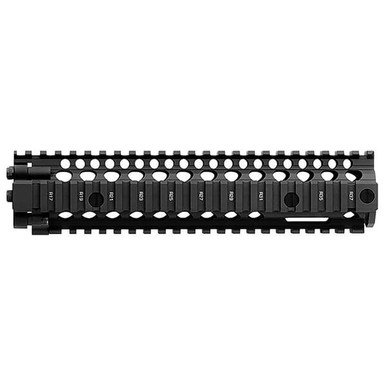
- A 15-inch BCM MCMR M-LOK handguard weighs 9.2 oz. A 9.55-inch Daniel Defense MK18 RIS II quad rail weighs 14.1 oz. The quad rail is heavier despite covering six fewer inches of barrel.
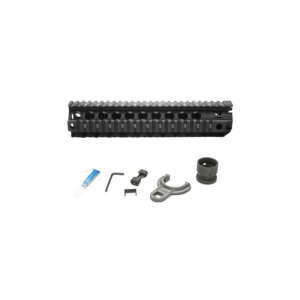
- Comparing same-length BCM handguards, the QRF-10 quad rail at 10 inches comes in at 12.3 oz versus 6.6 oz for the MCMR M-LOK in the same length. That's roughly 45% lighter.
- The NSWC Crane test (2017) showed M-LOK averaged 1.3 MOA of point-of-aim shift on reinstall versus KeyMod's 4.9 MOA, retained 100% of accessories in drop testing versus KeyMod's 33%, and in failure load testing demonstrated an increase of 215% in average sustained load over KeyMod, with M-LOK failing at loads as high as over three times the maximum failure load of KeyMod.
- Almost every modern M-LOK handguard still carries a full-length Picatinny top rail for optics. The two systems coexist by design.
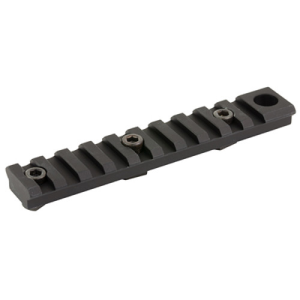
- M-LOK-to-Picatinny adapter sections add roughly 0.3 to 0.5 inches of height and bring back some of the weight you saved. Low-profile variants like the Arisaka sit as low as 0.277 inches over the mounting surface, while standard adapters run taller. Every adapter is an ounce-and-clearance penalty.
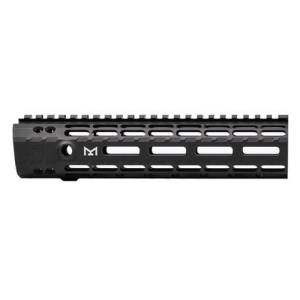
- In Q2 2026 builder data, the most-selected handguard was the Aero Precision Enhanced M-LOK at 564 selections. The runner-up, Midwest Industries Combat Rail, is also M-LOK. The market has voted.
- Picatinny quad rails still make sense for short-barreled, night-vision-heavy builds where you're stacking a white light, laser unit, pressure switch, front BUIS, and foregrip into a compressed rail space.
Arisaka M-LOK-to-Picatinny adapter Deals
Prices may change. May contain affiliate links.
Daniel Defense MK18 RIS II 9.55-inch Deals
Prices may change. May contain affiliate links.

Bravo company BCM MCMR M-LOK handguard 15-inch Deals
Prices may change. May contain affiliate links.
Bravo company BCM QRF-10 quad rail 10-inch Deals
Prices may change. May contain affiliate links.
Aero Precision Enhanced M-LOK handguard Deals
Prices may change. May contain affiliate links.
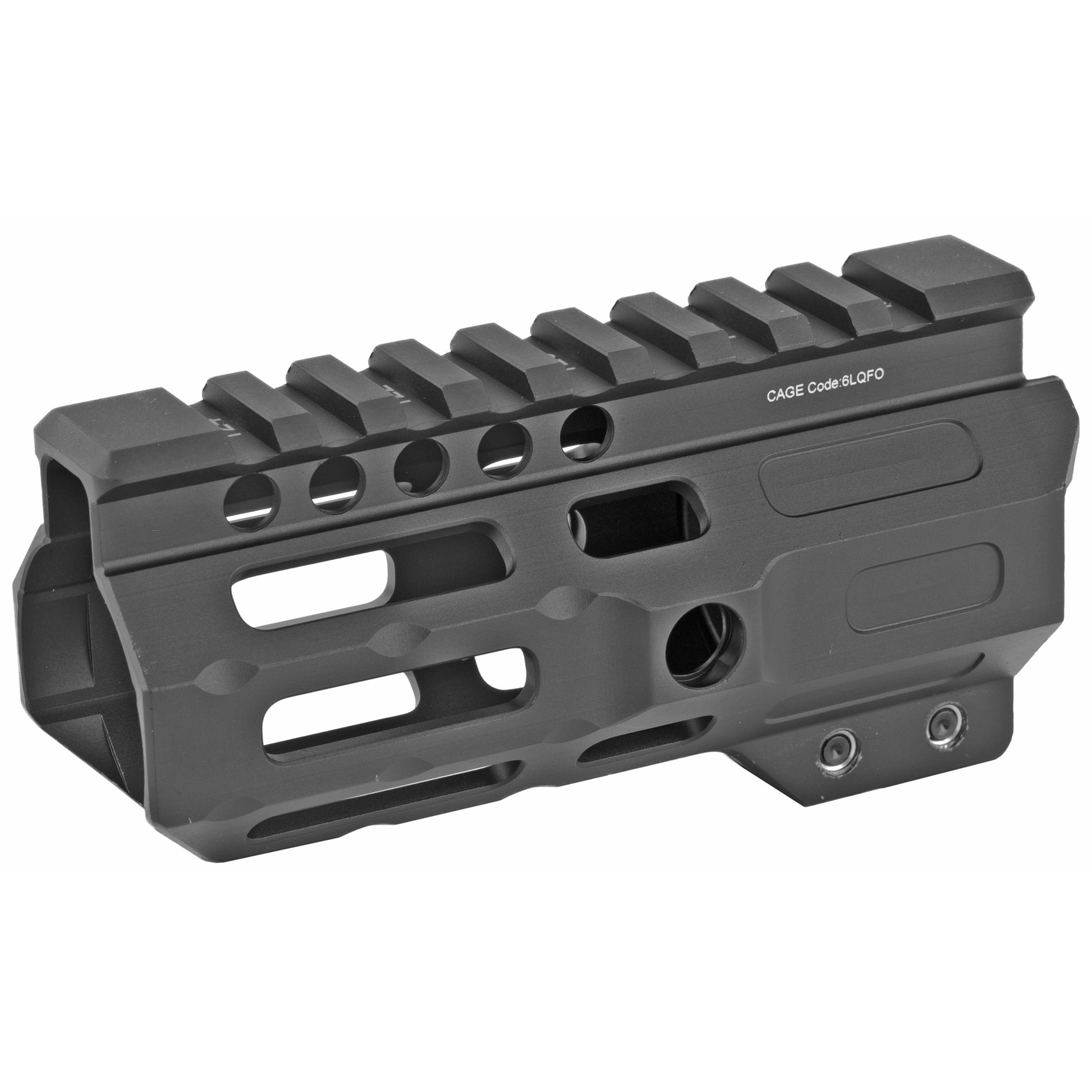
Midwest Industries Combat Rail M-LOK Deals
Prices may change. May contain affiliate links.

Test setup and methodology
The weight and performance numbers referenced here come from several distinct sources rather than a single controlled bench test, so understanding what was measured and by whom matters.
The NSWC Crane evaluation, conducted in 2017 for USSOCOM, tested M-LOK and KeyMod across three metrics: point-of-aim shift after accessory removal and reinstallation, accessory retention during drop testing, and static failure load. The Picatinny baseline wasn't the focus of that test since Picatinny was the established standard, but the results cemented M-LOK as the replacement for KeyMod and validated it against the older rail interface for repeatability.
The weight comparisons use manufacturer-published specs for specific handguards. The BCM QRF-10 (quad rail, 10 inches, 12.1 oz) versus the BCM MCMR (M-LOK, 10 inches, 6.6 oz) is a direct apples-to-apples comparison from the same manufacturer at the same length. The Daniel Defense MK18 RIS II at 14.1 oz for 9.55 inches versus the BCM MCMR at 9.2 oz for 15 inches illustrates the extreme end of the weight gap, though it's comparing different manufacturers and lengths.

Adapter height data (0.3 to 0.5 inches added by M-LOK-to-Picatinny sections) comes from accessory manufacturers. Builder selection data comes from a rifle configurator platform tracking organic builder choices through Q2 2026.
Limitations to flag up front
These aren't lab-controlled head-to-head tests on the same rifle with the same accessories and the same shooter. The weight numbers are manufacturer specs, which are generally reliable but can vary slightly between production runs. The NSWC Crane test compared M-LOK to KeyMod specifically, not M-LOK to Picatinny in a direct retention showdown. And builder selection data reflects market preference, not performance testing. Popularity doesn't equal superiority for every use case.
Weight: where the gap actually lives
Most people skip this part. They hear "M-LOK is lighter" and assume it's a marginal difference, maybe an ounce or two. The actual numbers are more dramatic than that.
The BCM comparison is the cleanest data point. Same manufacturer, same length, same era of production. The QRF-10 quad rail at 10 inches hits 12.1 oz. The MCMR M-LOK at 10 inches comes in at 6.6 oz. That's 5.5 oz of difference, or about 45% lighter for the M-LOK version. On a rifle that might weigh 6.5 to 7 pounds bare, shedding 5.5 oz from the handguard alone is significant. It shifts the balance point rearward, which changes how the rifle tracks between targets and how fatiguing it is to hold up during extended strings.
The Daniel Defense MK18 RIS II comparison makes the point even more starkly, though it's not a perfect apples-to-apples. That quad rail weighs 14.1 oz across just 9.55 inches. The 15-inch BCM MCMR covers six more inches of barrel at 9.2 oz. You're getting substantially more handguard for substantially less weight. The RIS II is a duty-grade quad rail built to mil-spec tolerances and designed to survive being thrown out of helicopters, so some of that weight is justified by its intended role. But for a civilian carbine class or home defense build, you're carrying rail surface you'll never use.
Here's what changes once you start adding accessories to the M-LOK handguard, though. Every M-LOK-to-Picatinny adapter section you bolt on claws back some of that weight savings. A short 3-slot aluminum adapter for a weapon light isn't heavy by itself, but stack two or three adapters for different accessories and you're eating into the advantage. The discipline with M-LOK is to mount directly wherever possible and use adapters only when a specific accessory demands Picatinny.

The heat factor nobody talks about
The shift from quad rails to slim M-LOK tubes brought a tradeoff that doesn't show up on a spec sheet. Those thick Picatinny rails on a quad handguard acted as heat sinks. The raised aluminum ridges added thermal mass between your hand and the barrel. Slim M-LOK handguards, with their thinner walls and fewer material protrusions, transfer barrel heat to your grip hand faster. After several rapid magazine dumps, you'll notice the difference. Rail covers and panels that slot into M-LOK slots exist specifically to address this. They add a few fractions of an ounce but restore the heat protection that the old quad rails provided by default.
Fit: how accessories actually attach
The mechanical difference between the two systems determines what you can mount, where you can mount it, and how much fiddling is involved.
Picatinny (MIL-STD-1913, standardized February 3, 1995) uses raised cross-slots at a consistent spacing. Accessories clamp directly onto the rail with a lever, thumbscrew, or throw lever. Installation is fast: slide the accessory onto the rail, tighten the clamp, done. The rail is always there whether you're using it or not, which means any Picatinny accessory can go anywhere on the rail surface without planning ahead.

M-LOK (Magpul's free-licensed standard, introduced in 2014) uses rectangular slots cut into the handguard wall. Though licensed free-of-charge, manufacturers must acquire a license from Magpul before producing M-LOK products, so it isn't strictly open-source in the conventional sense. Accessories attach by inserting a T-nut through the slot and torquing it down so the nut rotates perpendicular to the slot and locks against the inside of the handguard. It's a cleaner interface with no raised profile when empty, but installation takes a bit more time and a torque wrench is the correct tool for the job, not just finger-tight.
What you'll notice at the bench
The grip feel between the two systems is immediately obvious. A quad rail with bare Picatinny on all four sides has sharp edges that dig into your support hand. Most quad rail users end up covering three of the four rail faces with rubber or polymer covers, which adds weight and cost just to make the handguard comfortable. An M-LOK handguard with no accessories mounted is smooth. The slots are flush with the surface. You can run a C-clamp grip or a thumb-over-bore hold without rail bite.
Accessory positioning is more precise on M-LOK in some ways and less flexible in others. M-LOK slots are spaced at fixed intervals, so your mounting options are determined by where the slots fall. On a Picatinny rail, you can slide an accessory to any position along the continuous rail and lock it down. The difference matters most for weapon lights, where a quarter-inch of fore-aft position can change whether the light clears the muzzle device or casts a shadow from the barrel.

One thing that catches people: a QD sling swivel does not attach directly to an empty M-LOK slot. You need a QD socket or adapter first. On a Picatinny rail, QD adapters are also needed, but the assumption that M-LOK slots accept QD hardware natively is a common mistake.
The hybrid standard: why you're probably running both
Here's the spec that actually affects shooting decisions in 2026: essentially every modern M-LOK handguard ships with a full-length Picatinny rail on top. The Geissele MK16 Super Modular Rail has M-LOK on every quadrant and a full-length M1913 Picatinny top rail. The BCM MCMR has M-LOK slots on the sides and bottom with Picatinny on top. This isn't a compromise. It's the correct engineering answer.
Optics live on Picatinny. Red dots, LPVOs, magnifiers, backup iron sights, all of them use Picatinny quick-disconnect or clamp mounts. That interface isn't going away because it works perfectly for the job. The top rail stays Picatinny.
Everything else, the stuff that hangs off the sides and bottom of the handguard, is where M-LOK wins. Lights, foregrips, hand stops, bipod mounts, sling attachments, cable management panels. These accessories benefit from M-LOK's lower profile, lighter weight, and modular positioning.

The practical recommendation for any new build is straightforward: M-LOK handguard with a Picatinny top rail. M-LOK direct-mount accessories wherever possible. Picatinny on the top rail for optics. Adapter sections only when a specific Picatinny-only accessory demands them.
Common mistakes and how to avoid them
Buying adapters before checking for direct-mount options is the most frequent waste of money. The M-LOK accessory ecosystem has grown enormously since 2014. Lights like the Streamlight ProTac Rail Mount HL-X come with M-LOK compatibility. Magpul makes M-LOK vertical grips, hand stops, and bipod mounts that attach directly. The Magpul MOE QD Bipod mounts straight to M-LOK slots. Before you buy an adapter section, check whether a direct-mount version of your accessory exists. It usually does.

Streamlight ProTac Rail Mount HL-X Deals
Prices may change. May contain affiliate links.
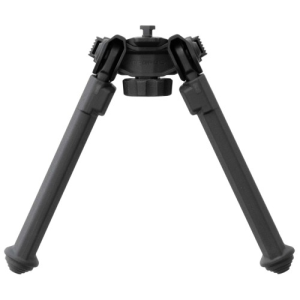
Magpul MOE QD Bipod M-LOK mount Deals
Prices may change. May contain affiliate links.
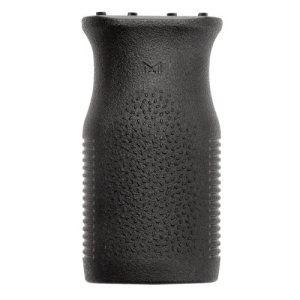
Magpul MOE M-LOK vertical grip Deals
Prices may change. May contain affiliate links.
Over-torquing M-LOK hardware is the second mistake. The T-nut system requires specific torque values. Too loose and the accessory shifts under recoil. Too tight and you can strip the threads or crack a polymer handguard. A small torque wrench or torque-limiting driver set to the manufacturer's spec is the right tool. Most people just crank it with an Allen key and hope for the best.
Mounting too many adapter sections defeats the purpose. If you find yourself bolting three or four Picatinny adapter sections onto an M-LOK handguard, you've essentially rebuilt a quad rail at a higher cost and with more potential failure points. At that point, a purpose-built quad rail would serve you better.
Ignoring the height penalty of adapters matters for weapon lights and lasers. Each M-LOK-to-Picatinny adapter section adds 0.3 to 0.5 inches of height. That changes the offset of your light or laser from the bore axis, which can affect zero and shadow patterns. On a short-barreled setup where clearances are tight, that extra height can push a light into the path of a suppressor or muzzle device.
Assuming M-LOK is always the right answer for every build is the last one. On a short-barreled rifle loaded with night-vision accessories, a compact quad rail can actually be the better choice. When you're trying to mount a white light, front BUIS, laser unit, remote pressure switch, and foregrip all within the area of the forend you actually grip, space gets tight fast. Some narrow M-LOK tubes create real estate problems when the top Picatinny rail is deleted in favor of more M-LOK slots. A quad rail solves accessory mounting by brute force: continuous rail on all four faces means anything clamps anywhere.

Handguards and products worth comparing
Five products illustrate the spectrum of what's available and how rail system choice plays out in practice.
Geissele MK16 Super Modular Rail
The URGI-length 13.5-inch version carries NSN 1005-01-672-4797, which tells you the military is actually buying these. M-LOK on seven sides with a full-length 1913 top rail. Geissele uses 7000-series aluminum with Type-3 Hardcoat anodizing, and anti-rotation tabs with set screws prevent the rail from rotating under any realistic conditions. This is the rail that replaced quad rails in elements of US SOF.

Geissele MK16 Super Modular Rail 13.5-inch Deals
Prices may change. May contain affiliate links.
BCM MCMR M-LOK handguard
The mid-tier M-LOK benchmark. The 15-inch version weighs 9.2 oz and has up to eight rows of M-LOK slots. Compared to BCM's own QRF-10 quad rail (12.1 oz at 10 inches), the weight savings are obvious. This is the handguard that shows up in most "best AR-15 handguard" discussions because it hits a solid middle ground between cost, weight, and build quality.
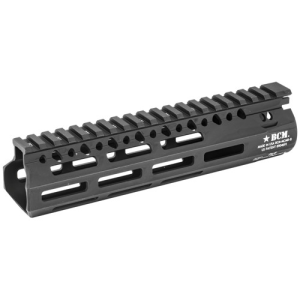
Bravo company BCM MCMR M-LOK handguard 10-inch Deals
Prices may change. May contain affiliate links.
Aero Precision Enhanced handguard
The most-selected handguard in Q2 2026 builder data with 564 organic selections. M-LOK mounting system. It occupies the budget-to-mid tier and has become the default recommendation for builders who want M-LOK without spending Geissele money. The Midwest Industries Combat Rail, also M-LOK, was the runner-up in the same dataset.
Daniel Defense MK18 RIS II
The quad rail that defined a generation of short-barreled rifles. At 14.1 oz for 9.55 inches, it's heavy by modern standards, but it was the issued handguard on the MK18 Mod 1 and remains the go-to for clone builds and short-barrel setups where maximum Picatinny real estate matters. If you're stacking accessories on a 10.3-inch barrel, continuous rail on all four faces solves the space problem that narrow M-LOK tubes sometimes create.

Magpul M-LOK-to-Picatinny adapter sections
Available in 3, 5, 7, 9, and 11-slot lengths. The polymer 9-slot version runs about $15.95. These are the bridge between M-LOK handguards and Picatinny-only accessories. Each section adds 0.3 to 0.5 inches of height. Short 3-slot pieces work well for lights or lasers. Longer sections handle bipods or foregrips. The key is to use as few as possible and go direct-mount wherever the accessory allows it.
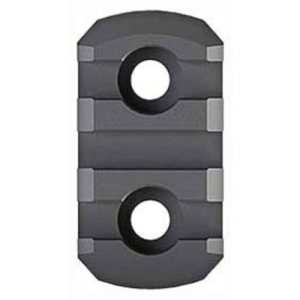
Magpul M-LOK-to-Picatinny adapter 3-slot Deals
Prices may change. May contain affiliate links.
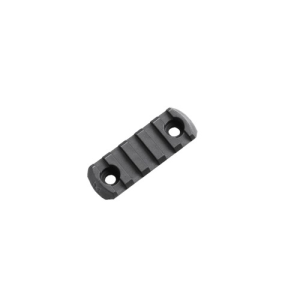
Magpul M-LOK-to-Picatinny adapter 5-slot Deals
Prices may change. May contain affiliate links.
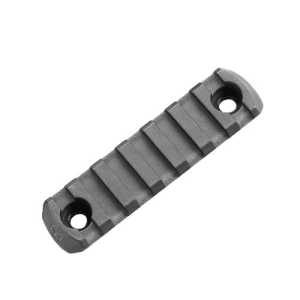
Magpul M-LOK-to-Picatinny adapter 7-slot Deals
Prices may change. May contain affiliate links.
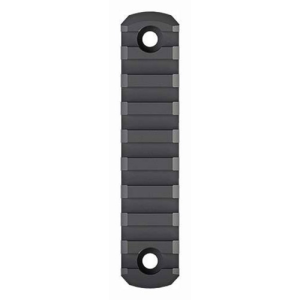
Magpul M-LOK-to-Picatinny adapter 9-slot Deals
Prices may change. May contain affiliate links.
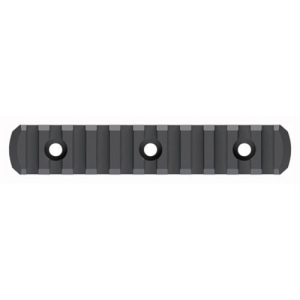
Magpul M-LOK-to-Picatinny adapter 11-slot Deals
Prices may change. May contain affiliate links.
What the numbers mean for your build
The 45% weight reduction from quad rail to M-LOK at the same length is not a marginal improvement. On a 16-inch carbine that you're running through a two-day class, that 5.5 oz off the front end translates directly into less fatigue during transitions, faster target-to-target movement, and a rifle that's easier to hold up during positional shooting. The balance point shift is the part people underestimate. Moving weight rearward toward the receiver makes the rifle feel lighter than the scale says it is, because your support hand isn't fighting as much leverage.
For a home defense rifle that lives in a closet and gets shot quarterly, the weight difference matters less. What matters more is accessory compatibility and speed of installation. If all your lights and grips are Picatinny, switching to an M-LOK handguard means either buying adapters or replacing accessories. The cost of the handguard swap plus new direct-mount accessories can add up fast.
The builder data tells a clear story about where the market has landed. M-LOK is the default for new builds. But "default" doesn't mean "universal." The MK18 RIS II is still in production for a reason. Quad rails solve a specific problem, the problem of maximum accessory density in a short space, and they solve it without adapters, without torque wrenches, and without worrying about whether your T-nut rotated properly.
The NSWC Crane test validated M-LOK's mechanical reliability against KeyMod, not against Picatinny directly. But the retention and repeatability numbers (100% accessory retention in drops, 1.3 MOA reinstall shift) establish that M-LOK isn't giving up durability for its weight savings. The system is mechanically sound under hard use.
Caveats and limitations
The weight comparisons use manufacturer specs from different companies. BCM-to-BCM is clean, but BCM-to-Daniel Defense introduces variables in material, construction method, and design philosophy. The MK18 RIS II is built to a military durability standard that may include design choices (thicker walls, heavier barrel nut) contributing to its weight beyond just the rail profile.
The NSWC Crane test is from 2017. Both M-LOK and KeyMod accessories have evolved since then, though the fundamental mechanical principles haven't changed. The test also used specific accessories and specific handguards, and results could vary with different combinations.
Builder selection data reflects what people are buying, not what performs best in a controlled test. The Aero Precision Enhanced handguard's popularity could be driven partly by price point and availability, not just technical merit.
Adapter height measurements (0.3 to 0.5 inches) are approximate ranges, not precise measurements for every adapter on the market. Specific products may fall outside this range.
Environmental conditions, round counts, and long-term wear patterns aren't captured in any of the data referenced here. How an M-LOK T-nut holds up after 10,000 rounds of sustained use versus a Picatinny clamp is a question the available data doesn't fully answer.
What to do next
If you're building new, start with an M-LOK handguard with a Picatinny top rail. That's the industry standard configuration for a reason. Buy direct-mount M-LOK accessories first and only add Picatinny adapter sections for accessories that genuinely don't have an M-LOK version.
If you're on a quad rail and happy with it, don't switch just because the internet says M-LOK is better. Weigh your rifle as it sits right now, loaded, with all accessories mounted. Then weigh it with the M-LOK handguard and equivalent accessories you'd need to buy. If the savings are meaningful to you and worth the cost of the swap, go for it. If your rifle runs fine and you're not fighting fatigue, keep shooting.
Run a simple test after any rail swap or accessory mount change. Zero your optic, remove and reinstall each accessory twice, and confirm zero holds. Check torque on M-LOK hardware after your first range session, about 100 rounds. T-nuts can settle slightly during initial use. Recheck torque, confirm everything is tight, and then leave it alone. That five-minute check saves you from chasing a wandering zero three range trips later.
