
You want thermal on your rifle, but you don't want to spend Pulsar Thermion 2 money to get there. Fair. The sub-$2,000 thermal market has changed dramatically in the last two years. Sensors that were exclusive to $4,000+ units in 2022 are showing up in scopes that cost half that now. The problem isn't finding a cheap thermal scope. The problem is finding one that's actually usable as a weapon sight and not just a glorified thermal monocular bolted to a Picatinny rail.

This is the price range where you'll find real 12-micron sensors, usable refresh rates, and reticle options that don't make you feel like you're aiming through a 1990s video game. But it's also the range where manufacturers cut corners in ways that aren't obvious on a spec sheet. Battery life gets exaggerated. Detection range numbers are calculated under ideal conditions that don't exist in the field. And some of these scopes have eye relief so tight that managing recoil on anything above .223 becomes a problem. The specs that matter and the specs that lie are different animals in thermal, and sorting them out is the whole game below two grand.
What follows is a practical breakdown of what's actually worth mounting in this price bracket, what the spec sheets aren't telling you, and which corners you can live with versus which ones will send you back to the forums looking for an upgrade six months from now.
The specs that actually matter under $2,000
Thermal scope specs read like a foreign language if you're coming from traditional glass, and manufacturers know this. They'll lead with detection range numbers and resolution figures that sound impressive but don't translate to field performance the way you'd expect.
Sensor resolution is the first number everyone looks at. At this price point, you're mostly seeing 384x288 sensors, with a few 320x240 units hanging around at the bottom of the bracket. The 384x288 sensor is the sweet spot for sub-$2,000 money. You'll occasionally see a 640x512 sensor creep into this range, but it's rare, and when it does show up, something else usually got sacrificed to hit the price point. The pixel pitch matters just as much as the resolution. A 12-micron pixel pitch on a 384x288 sensor will give you a noticeably sharper image than a 17-micron pitch at the same resolution. Most of the competitive options in this bracket have moved to 12-micron sensors, and that's a genuine improvement over what was available even two years ago.
Refresh rate is the spec that separates a weapon sight from a scouting tool. You want 50Hz. Period. A 30Hz refresh rate introduces visible lag when you pan the scope, and that stutter becomes a real problem when you're tracking a moving hog at 80 yards. Some budget thermals still ship at 30Hz, and manufacturers don't always make this obvious. If the spec sheet says "up to 50Hz" without clarifying, dig deeper.

Detection range versus recognition range versus identification range: this is where the marketing gets thick. Detection range means the scope can tell you something warm is out there. Recognition range means you can tell it's an animal versus a rock that absorbed afternoon sun. Identification range means you can tell it's a hog and not a deer. The identification range is the number that matters for hunting, and it's always the smallest of the three. A scope advertising 1,500-yard detection range might only give you reliable identification at 300-400 yards. That's not a flaw; that's physics. But if you're buying based on the big number, you'll be disappointed.
NETD (Noise Equivalent Temperature Difference) is the sensitivity spec. Lower is better. Anything under 40mK is solid for this price range. Sub-25mK units exist but usually live above $2,000. The practical difference: a lower NETD scope will show you more thermal contrast in conditions where the temperature differential between your target and the background is small. Early morning hunts when the ground is still warm, or late-season sits when everything is cold, are where this number earns its keep.
What you'll actually notice at the range
The first time you mount a sub-$2,000 thermal and look through it, you'll notice two things immediately. First, the image quality is genuinely usable for shooting. Second, it's not as crisp as the $4,000 scope your buddy has. That gap is real, but it's narrower than it used to be.
Eye relief on most budget thermals runs between 45mm and 50mm. That's adequate for .308 and below, but it gets tight on magnum platforms. If you're running a .300 Win Mag, pay close attention to this spec and consider adding a rubber eyecup. The display inside the eyepiece is typically AMOLED or LCOS at this price point, and the quality difference between those two technologies has largely closed. What matters more is the display resolution relative to the sensor resolution. A 384x288 sensor feeding a 1024x768 display will look sharper than the same sensor feeding a lower-res display, because the display isn't the bottleneck.

Zeroing a thermal scope is different from zeroing traditional glass. Most units in this bracket use a digital zero system where the reticle moves on the display rather than a mechanical adjustment moving the optic path. This means your zero is stored in software. If the scope resets, loses firmware, or has a battery issue, your zero can potentially walk. The better units in this bracket store zero profiles that survive power cycles and battery swaps. Ask about this before you buy, because re-zeroing a thermal scope every time you swap batteries is not how you want to spend your evening.
The reticle options on budget thermals have improved significantly. Most now offer multiple reticle styles, color options, and the ability to adjust reticle position without losing your zero reference. Some even include basic ballistic drop compensation. The reticle is your interface with the target, and having one that works for your shooting style matters more than an extra 50 yards of detection range.
Five scopes worth evaluating
The sub-$2,000 thermal market has real options now, not just one or two tolerable choices. Here are five units that represent the competitive field, each with a different approach to hitting this price point.
AGM Rattler V2 35-384
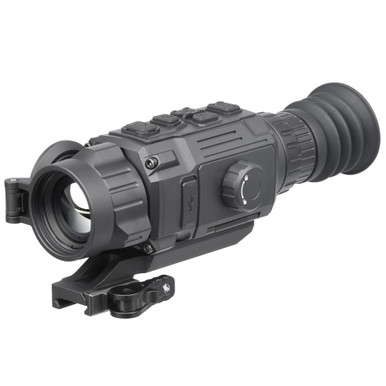
AGM has been aggressive in this space, and the Rattler V2 35-384 is their most compelling entry for the money. It runs a 384x288 sensor with 12-micron pixel pitch at 50Hz. The 35mm objective lens gives it a reasonable field of view without making the unit unwieldy. Magnification runs 2x base with digital zoom up to 16x, though anything past 8x digital starts degrading the image noticeably. The detection range sits around 1,300 yards under good conditions, with practical identification range closer to 350-400 yards on a hog-sized target.
AGM Rattler V2 35-384 Deals
Prices may change. May contain affiliate links.
What makes the Rattler V2 interesting is the form factor. It's compact enough to mount on an AR-platform rifle without turning it into a front-heavy mess. The eye relief is listed at 45mm, which is workable on most intermediate cartridges. Battery life runs around 4-5 hours on internal batteries, which is honest for this class. AGM also includes Wi-Fi streaming capability, which is more useful than it sounds if you're trying to show a hunting partner what you're seeing without handing over the rifle.

The trade-off: the Rattler V2's image processing can lag behind Pulsar's in terms of scene detail, particularly in low-contrast thermal environments. It's not bad, but side-by-side with a Thermion, you'll see the difference.
ATN ThOR 4 384 4.5-18x
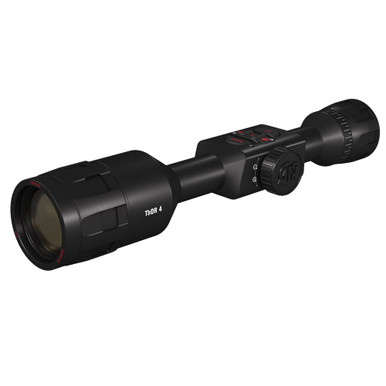
ATN takes a different approach. The ThOR 4 packs features into the unit that other manufacturers leave out entirely at this price. You get a 384x288 sensor, ballistic calculator, video recording, Wi-Fi, Bluetooth, a gyroscope, and a barometric altimeter. The magnification range is 4.5-18x, which sounds impressive until you remember that the base optical magnification is fixed and everything else is digital zoom.
ATN ThOR 4 384 4.5-18x Deals
Prices may change. May contain affiliate links.
The ATN's strength is its smart features. The ballistic calculator actually works once you input your load data, and the ability to record hunts directly through the scope is genuinely useful. The one-shot zero system ATN uses is also faster than the traditional multi-shot process most thermals require.
The trade-off here is image quality. ATN's thermal image processing has historically lagged behind Pulsar and AGM in terms of raw clarity. The ThOR 4's sensor is 60Hz capable, which is a plus, but the image can appear slightly softer than competitors at the same resolution. The unit is also larger and heavier than the Rattler V2, which affects how it handles on lighter rifles. Battery life is around 18 hours on the internal lithium pack, though real-world use with Wi-Fi and recording active cuts that significantly.
Pulsar Thermion 2 XQ38
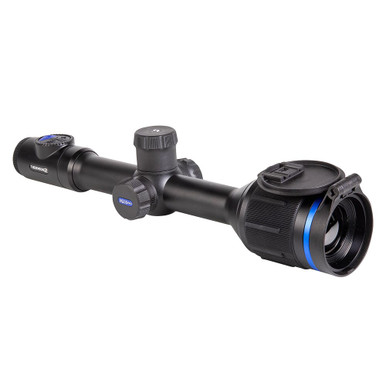
Pulsar is the name most people know in thermal, and the Thermion 2 XQ38 sits right at the top of the sub-$2,000 bracket. It runs a 384x288 sensor with 17-micron pixel pitch, which is larger than the 12-micron units from AGM. On paper, that sounds like a step backward. In practice, Pulsar's image processing algorithms compensate well, and the Thermion 2 XQ38 produces a clean, usable image that competes with 12-micron units from other brands.
Pulsar Thermion 2 Deals
Prices may change. May contain affiliate links.
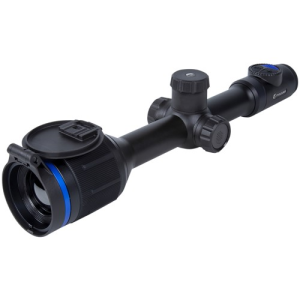

The Thermion 2 XQ38's biggest advantage is build quality and software maturity. Pulsar has been making thermal scopes longer than most of the competition, and it shows in the menu system, the zeroing process, and the overall reliability of the platform. The scope uses a traditional riflescope form factor with 30mm tube mounting, which means you can use standard rings. That's a real advantage if you already have a ring setup you trust.
Detection range is around 1,350 yards, with identification range in the 350-yard neighborhood on medium-sized game. Refresh rate is 50Hz. Battery life is approximately 7-8 hours on the internal pack, with an option for external power via USB-C.
The downside: the 17-micron pixel pitch does show its limitations at longer ranges where fine detail matters. If you're trying to positively ID targets past 400 yards, the 12-micron competition has an edge.
Armasight Contractor 320 3-12x
The Contractor 320 comes in at the lower end of this price bracket and makes no apologies for its compromises. It runs a 320x240 sensor with a 25-micron pixel pitch, which is the oldest sensor technology in this lineup. The 60Hz refresh rate is a plus, and the 3-12x magnification range (with digital zoom) gives it reasonable versatility.
Rma armament Armasight Contractor 320 3-12x
May contain affiliate links.
Why include a 320x240 unit? Because the Armasight Contractor 320 is often available well under $1,500, and for someone who's primarily hunting hogs inside 200 yards, the resolution difference between 320x240 and 384x288 is less dramatic than the spec sheets suggest. At close to moderate range, the image is perfectly usable for target identification and shot placement. The unit is also built tough, with a MIL-STD-810 rating and a form factor that handles recoil on .308 platforms without complaint.
The trade-off is obvious: you're giving up resolution and detection range compared to the 384-sensor competition. Past 250 yards, the image gets soft enough that positive identification becomes difficult on smaller targets. If your use case is short-range predator or hog work, that might not matter. If you want to stretch past 300, look elsewhere.
InfiRay Outdoor RICO Micro RH25
InfiRay has been pushing hard into the thermal market, and the RICO Micro RH25 represents their compact entry. It uses a 384x288 sensor with 12-micron pixel pitch, and the 25mm objective keeps the unit small and light. The base magnification is 2x with digital zoom to 16x. Refresh rate is 50Hz. The NETD rating of sub-25mK is genuinely impressive for this price bracket and translates to better image contrast in challenging thermal conditions.
InfiRay RICO Micro RH25
May contain affiliate links.

The RICO Micro's standout feature is its size. It's small enough to use as a clip-on in front of a day scope if you have the right adapter, which gives it dual-purpose utility that the larger units can't match. The image quality punches above its price point, particularly in the sub-200-yard range where the 25mm objective isn't limiting your field of view.
The limitation is range. The smaller objective lens means less thermal energy collection, which translates to shorter effective detection and identification distances compared to 35mm or 50mm objective units. If you need to reach past 300 yards consistently, the RH25's 25mm objective will feel limiting. For close-range work on hogs and predators, it's one of the best values in the bracket.
Common mistakes that cost you money or performance
Buying based on detection range alone is the single most common error. That 1,500-yard detection number means the scope can register a thermal signature at that distance. It does not mean you can identify, aim at, or ethically shoot anything at 1,500 yards through a 384x288 sensor. Buy based on identification range, and cut the manufacturer's number by 15-20% to account for real-world conditions like humidity, rain, and temperature differentials that don't match the test environment.
Ignoring the mounting system is the second mistake. Some budget thermals use proprietary mounts that don't interface well with standard Picatinny rails, or they sit so high that getting a proper cheek weld requires an aftermarket riser. Before you buy, verify the mounting height and whether it's compatible with your stock setup. A scope you can't get behind consistently is a scope that won't shoot accurately, regardless of its sensor quality.

Expecting traditional glass eye box behavior will frustrate you. Thermal scopes have a display inside the eyepiece, not a traditional optical path. The eye box is more forgiving in some ways (you don't get the same blackout effect from slight misalignment) but less forgiving in others (the display can wash out or distort at extreme angles). Spend time behind the eyepiece before your first hunt, because the sight picture is fundamentally different from what you're used to.
Skipping the NUC calibration cycle is a mistake that shows up in the field. NUC (Non-Uniformity Correction) is the process where the thermal sensor recalibrates itself. Most scopes do this automatically at intervals, and when it happens, the image freezes for a fraction of a second. You can also trigger it manually. If you don't NUC before taking a shot, you might be looking at a slightly degraded image with thermal artifacts that obscure detail. Get in the habit of triggering a manual NUC before any critical observation or shot.
Forgetting about battery management in cold weather will end your hunt early. Lithium batteries lose capacity in cold temperatures, and thermal scopes draw more power than traditional illuminated reticles. If the manufacturer says 5 hours of battery life, plan for 3.5 in freezing conditions. Carry spare batteries and keep them warm in an inside pocket. Some scopes accept external USB power banks, which is worth its weight in gold during extended sits.
Glass notes: what the image actually looks like
Thermal imaging doesn't look like what movies show you. The image is a representation of temperature differentials, not a photograph. In white-hot polarity (the most common mode for hunting), warm objects appear bright against a darker background. The quality of that image depends on the sensor resolution, the pixel pitch, the NETD sensitivity, and the image processing algorithms the manufacturer uses.
At 384x288 with 12-micron pitch, you'll see a recognizable animal shape with enough detail to distinguish species and assess body position at ranges inside 300 yards. You won't see antler tines clearly. You won't see facial features. What you will see is the thermal outline of the animal, the heat signature of its body cavity, and enough detail to place a shot on the vitals.

Color palettes matter more than most buyers realize. White-hot is standard, but many experienced thermal hunters prefer black-hot for certain conditions, and some of the newer color palettes (like InfiRay's "Ironbow" or Pulsar's "Rainbow") can help distinguish subtle temperature differences that white-hot flattens. Spend time cycling through the palette options on your specific scope before deciding which one works best for your eyes and your hunting environment.
In heavy fog, rain, or dense humidity, thermal performance degrades across all price points. Thermal radiation gets absorbed and scattered by water vapor. A $5,000 scope handles this better than a $1,500 one, but neither is immune. If you hunt in consistently wet environments, factor this into your expectations.
How to actually evaluate your thermal scope
Once you've mounted and zeroed your scope, run this sequence before you trust it in the field. First, verify zero at 100 yards on a thermal-compatible target. Steel plates work, but a warm hand warmer taped to a target backer gives you a precise aiming point. Shoot a three-round group and verify point of impact matches point of aim.

Second, test your identification range. Set up a target at 200 yards, then 300, then 400. At each distance, evaluate whether you can positively identify what you're looking at. Not detect it. Identify it. This is your real maximum ethical range with that scope, and it's almost certainly shorter than the spec sheet suggests.
Third, test the NUC cycle timing. Watch the scope for 15-20 minutes of continuous use and note how often the automatic NUC fires and how long the image freeze lasts. If it's happening every 3-4 minutes with a half-second freeze, that's normal. If it's happening more frequently or the freeze is longer, the sensor may be struggling with the ambient conditions.
Fourth, test battery life under realistic conditions. Turn on Wi-Fi if you plan to use it. Run the scope at your preferred brightness and palette. Time how long the battery actually lasts versus the manufacturer's claim. This gives you your real-world planning number for hunt duration.
Finally, shoot a group, power the scope off completely, swap the battery, power it back on, and shoot another group at the same target. If the point of impact shifted, your scope isn't holding zero through power cycles, and that's a problem you need to solve before hunting season. Some scopes require you to re-select your zero profile after a restart. Know your scope's behavior so it doesn't surprise you when it matters.
The sub-$2,000 thermal market is the best it's ever been, but it still requires you to understand what you're buying and what you're giving up. Pick the scope that matches your actual use case, not the one with the most impressive spec sheet. A 384x288 sensor with 12-micron pitch and 50Hz refresh rate is the baseline to target. Everything above that is a bonus. Everything below it is a compromise you should make intentionally, not accidentally.