You own a rifle but you live in an apartment. The nearest range that allows rifle calibers is 45 minutes away, costs money every visit, and you can only get there twice a month if you're lucky. So the rifle sits in the safe, and your fundamentals slowly erode between range trips.
Here's the thing: most of what makes a good rifle shooter has nothing to do with recoil or noise. Trigger control, natural point of aim, sight tracking, breathing, and positional stability are all trainable without a single round. Twenty minutes of focused dry fire in your living room, three to four times a week, will do more for your shooting than a monthly mag dump at an indoor range. But you need a plan, and you need to account for the realities of doing this in a small space with shared walls and neighbors.
This is a complete 20-minute dry fire session built for apartments. No garage, no backyard, no 25-yard hallway required. Just your rifle, a safe direction, and a timer.
Before anything else: make the space safe
Clear the rifle. Then clear it again. Remove all live ammunition from the room; not just from the magazine, from the entire room. Put it in another room behind a closed door. This isn't optional and it isn't paranoia. Negligent discharges during dry fire happen because someone "just loaded one mag real quick" or left a round on the desk. Eliminate the possibility entirely.
Pick a safe direction. In an apartment, this means a direction where a negligent discharge would do the least harm. Exterior brick or concrete walls are ideal. Interior drywall won't stop anything meaningful. If your apartment has a concrete exterior wall, that's your dry fire wall. Aim toward it for every rep. If you don't have a good backstop direction, consider a purpose-built ballistic panel rated for rifle calibers; they exist, they're compact, and they turn any wall into a viable safe direction.
Once the space is set, declare it out loud: "The rifle is clear, no live ammo in the room, safe direction is [that wall]." It sounds silly. Do it anyway. Build the ritual so it becomes automatic.
The gear you actually need
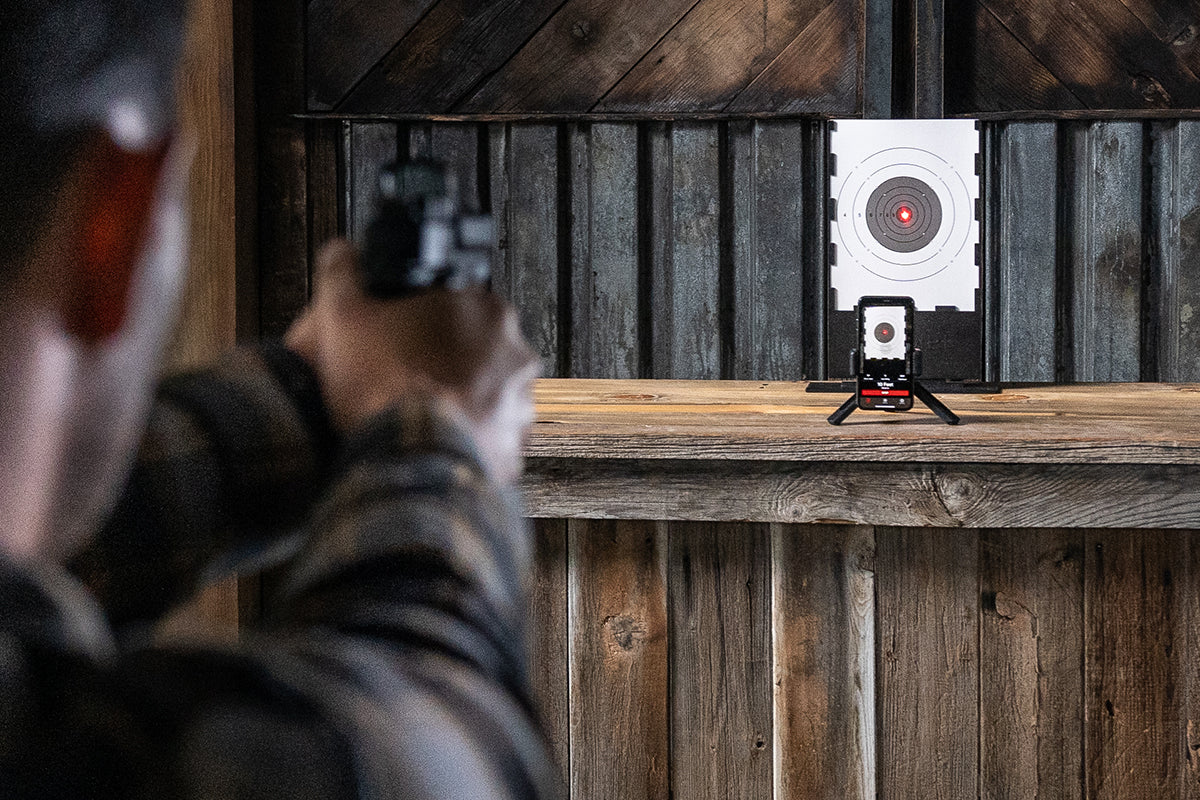
The rifle, obviously. An LPVO, red dot, or irons; whatever you normally run. A shot timer with a par time function (a phone app works fine for dry fire). A small aiming target taped to the wall at roughly the height you'd engage targets; a 2-inch dot or a 3x5 index card works perfectly at room distance. That's the minimum.
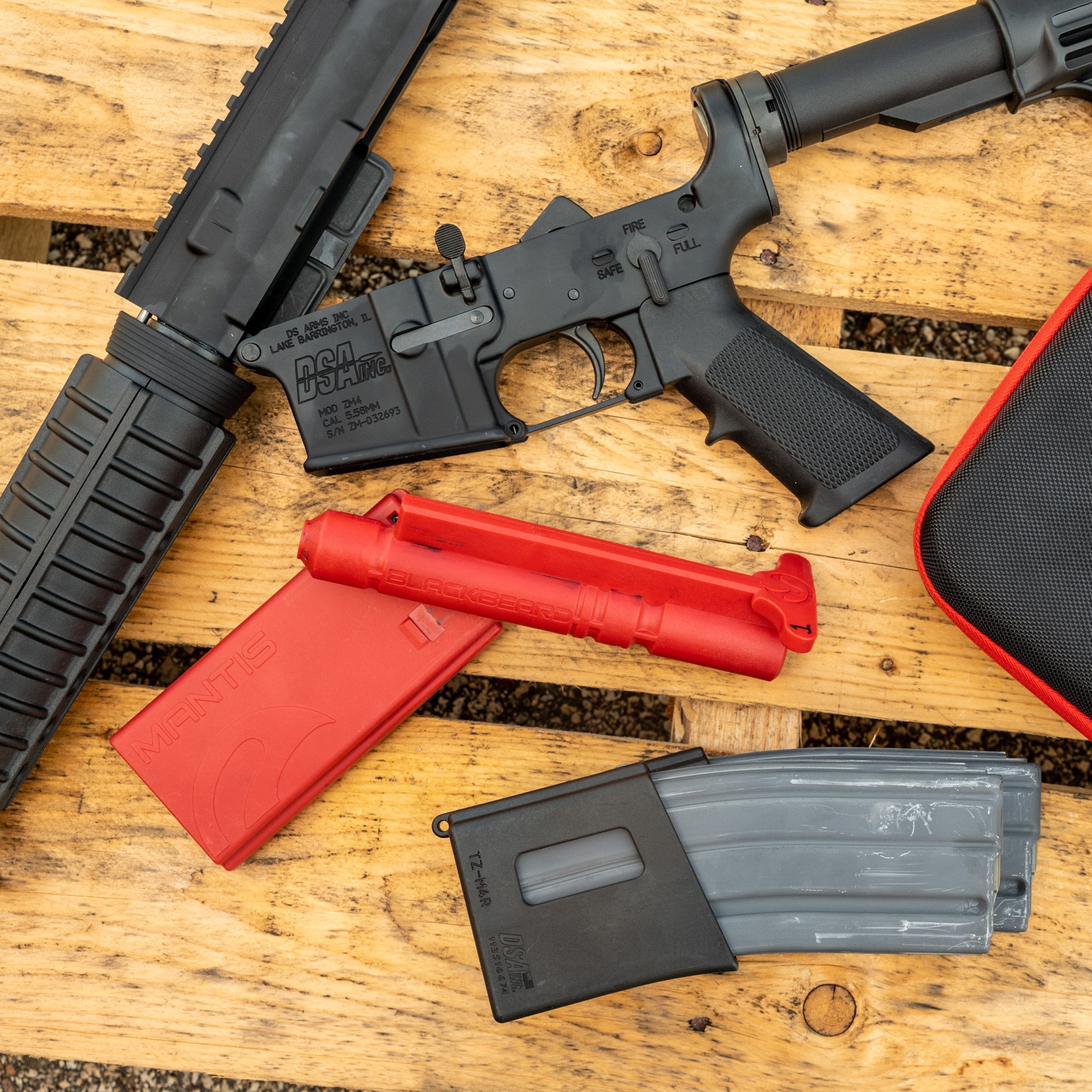
If you want feedback beyond what your eyes can tell you, a MantisX sensor mounted to your rail will track muzzle movement through the trigger press and give you a score. It's genuinely useful for diagnosing problems you can't feel yet. Laser training cartridges that chamber in your rifle and emit a brief flash on trigger pull are another option; pair one with a laser-reactive target and you get immediate hit/miss feedback at room distances. Neither is required. Your eyes on the sights and honest self-assessment will get you 80% of the way there.
Snap caps are worth having. They protect your firing pin on repeated dry fire, and more importantly, they let you practice loading, charging, and manipulating the rifle realistically. Pick up a pack of five or six in your caliber.
The 20-minute session
This session has four blocks. Each one isolates a specific skill. Run them in order; they build on each other.
Block 1: natural point of aim check (3 minutes)
Get into your primary shooting position; whatever you'd use most often. For apartment dry fire, that's probably standing unsupported or kneeling, since going prone in a 12x14 living room gets awkward fast.
Close your eyes. Mount the rifle to your shoulder. Settle into position. Open your eyes. Where are the sights pointing relative to your target? If they're not on the dot, you're fighting your body to hold the rifle on target, and that fight creates tension, tremor, and inconsistency.
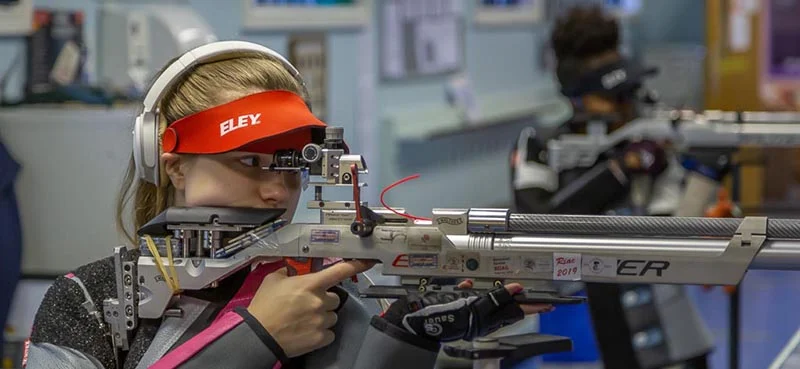
Adjust your feet, your hips, your whole body position; not your arms; until the sights open up naturally onto the target. Close eyes, settle, open, check. Repeat five to six times until the sights land on or within an inch of your aiming point every time.
This is the single most skipped fundamental in rifle shooting. If your natural point of aim is off, every other skill is compensating for it.
Block 2: trigger press and hold (7 minutes)
This is the meat of the session. Set your timer to a 3-second par time.
On the beep, press the trigger straight to the rear while keeping the sights perfectly still on the dot. The goal is zero sight movement at the moment the striker or hammer falls. After the click, hold the trigger to the rear and maintain sight picture for a full second. That hold; the follow-through; is where you'll see the truth. Did the sights jump left? Dip low? That's your diagnostic.
Run 15 reps at the 3-second par time. You're not rushing. Three seconds is generous. The focus is pure stillness through the break.
Then drop to a 2-second par time and run 10 more reps. The compressed timeline will expose any flinch or jerk you've been hiding at the slower speed.
After each rep, honestly assess: did the sights stay on the dot through the break and follow-through? If yes, that's a clean rep. Track your clean reps out of 25 total. Fifteen or more clean reps is a solid session. Below 10, slow down and stay at 3 seconds until it improves.
Block 3: transitions and target acquisition (5 minutes)
Tape a second aiming dot to the wall, roughly 3 to 4 feet from the first one. At room distance, this simulates a meaningful angular transition.
Start with the rifle mounted, sights on dot one. On the beep, transition to dot two, settle the sights, and press a clean shot. Par time: 2.5 seconds. Run 8 reps alternating directions; dot one to dot two, then dot two to dot one.
What you're training here is the eyes leading the rifle. Your eyes should snap to the second target before the muzzle arrives. The rifle follows the eyes, not the other way around. If you're sweeping the muzzle over and then hunting for the dot, you're doing it backwards.
Then run 4 reps with no par time, focusing purely on the smoothness of the transition. Fast transitions come from efficiency, not effort. The muzzle should move in a straight line between targets with no overshoot and no oscillation at the end.
Block 4: position changes (5 minutes)
Start standing. On the beep, drop to kneeling, mount the rifle, acquire the dot, and press one clean shot. Par time: 4 seconds to start. Run 5 reps.
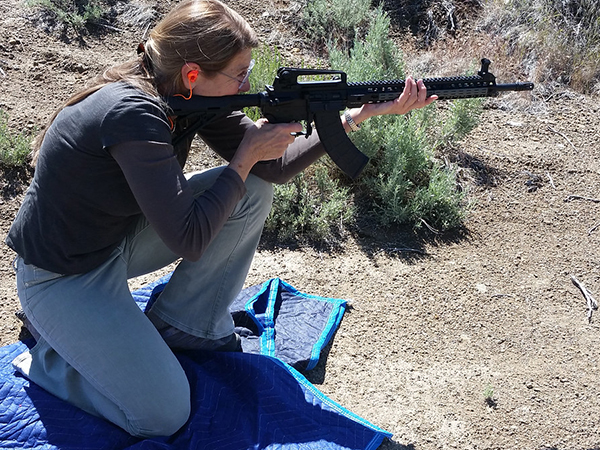
Then reverse it: start kneeling, stand up, acquire, press. Same par time, 5 reps.
In an apartment, you probably can't go prone-to-standing, and that's fine. Standing to kneeling and back covers the most common real-world position change. The skill here is building a stable position quickly; finding your natural point of aim under time pressure instead of muscling the sights onto target.
If 4 seconds feels easy and your sight picture is clean at the break, drop to 3.5 seconds. If you're rushing and the sights are bouncing when you press, add time. The shot has to be clean or the rep doesn't count.
What you'll feel when it clicks
There's a moment; usually a few sessions in; where the trigger press stops being a conscious mechanical action and starts being something that just happens while you maintain sight focus. The sights will be steady on the dot, and the click will almost surprise you. That's a compressed surprise break, and it's the gold standard for trigger control. You can't force it. You train into it through repetition with focus.
Common mistakes that wreck apartment dry fire
Most people start strong and then let the session degrade. Here's what goes wrong.
Going too fast too soon is the biggest one. Dry fire isn't about speed. It's about building clean motor patterns. If you're rushing to beat the par time and your sights are dancing at the break, you're training yourself to miss faster. Slow down. Speed is a byproduct of efficiency, and efficiency comes from slow, correct reps.
Skipping the natural point of aim check turns every subsequent rep into a fight against your own skeleton. Three minutes at the start saves you from 17 minutes of compensating with tension.
Practicing without a target; just pressing the trigger at a blank wall; removes all accountability. You need a specific, small aiming point to know whether your sights moved. A blank wall lets you lie to yourself.
Running the session while distracted kills the value. TV on, phone buzzing, half-focused. Twenty minutes of genuine concentration beats an hour of going through the motions. If you can't focus for 20 minutes, do 10 focused minutes instead.
Neglecting follow-through is the silent killer. The instant after the click, most people drop the rifle or shift their eyes. Hold the sights on target for a full second after every press. That post-shot discipline translates directly to live fire, especially for calling shots and staying in the scope for follow-up.
Tracking progress and knowing when to push
Keep a simple log. Date, number of clean reps out of total reps for each block, and any par times you hit or missed. You don't need a spreadsheet; a notes app on your phone works. What matters is the trend over weeks.
When you're hitting 20+ clean reps out of 25 in block two at the 2-second par time consistently across three sessions, drop to 1.5 seconds. When your transitions in block three are smooth and clean at 2.5 seconds, go to 2 seconds. When position changes are solid at 4 seconds, push to 3. The standards are progressive, but only move forward when the current standard is boring because it's easy; not because you're impatient.
Every two weeks, run the full session cold; no warm-up reps, no practice presses. Just the timer and the dots. Your cold performance is your real skill level. That's the number that matters, and that's the number that'll translate to live fire when you finally get to the range.
Three to four sessions a week, 20 minutes each, and you'll see measurable improvement in your live fire groups within a month. The rifle doesn't need to leave the apartment for you to get better with it. It just needs a plan, a target, and your full attention for 20 minutes.