Comparing AR-15 dry-fire aiming systems: which one actually works?
Most shooters who dry fire their AR-15 do the same thing: rack the charging handle, press the trigger, hear a click, repeat. No feedback. No data. No idea whether that trigger press was clean or garbage. You're just guessing; and guessing isn't training.
The good news is there are now several systems designed to give you actual feedback during AR-15 dry fire. The bad news is they all work differently, cost differently, and solve different problems. Some track your muzzle movement. Some show you where your "shot" landed with a laser. One even gives you recoil. Picking the wrong one means spending $100 to $400 on something that collects dust in your range bag.
Here's the breakdown of what's currently on the market, what each system actually does well, and which one fits the way you train.
What you're really choosing between
These systems fall into three categories: motion sensors that track muzzle behavior, laser-based systems that register shot placement on a target, and recoil-driven systems that simulate the firing cycle. Each category answers a different training question.
Motion sensors like the MantisX answer "what is my muzzle doing before, during, and after the trigger press?" Laser systems like Strikeman and the Mantis Laser Academy answer "where did my shot hit?" Recoil systems like the CoolFire Trainer answer "can I manage follow-up shots and stay on target through the firing cycle?" None of them answer all three questions perfectly. That's the trade-off.
MantisX Blackbeard
The Blackbeard is purpose-built for the AR-15. It replaces your bolt carrier group and magazine with a drop-in system that resets the trigger after every press, no more racking the charging handle between reps. It also includes a laser that registers on the MantisX app, and the sensor tracks your muzzle movement through each rep.
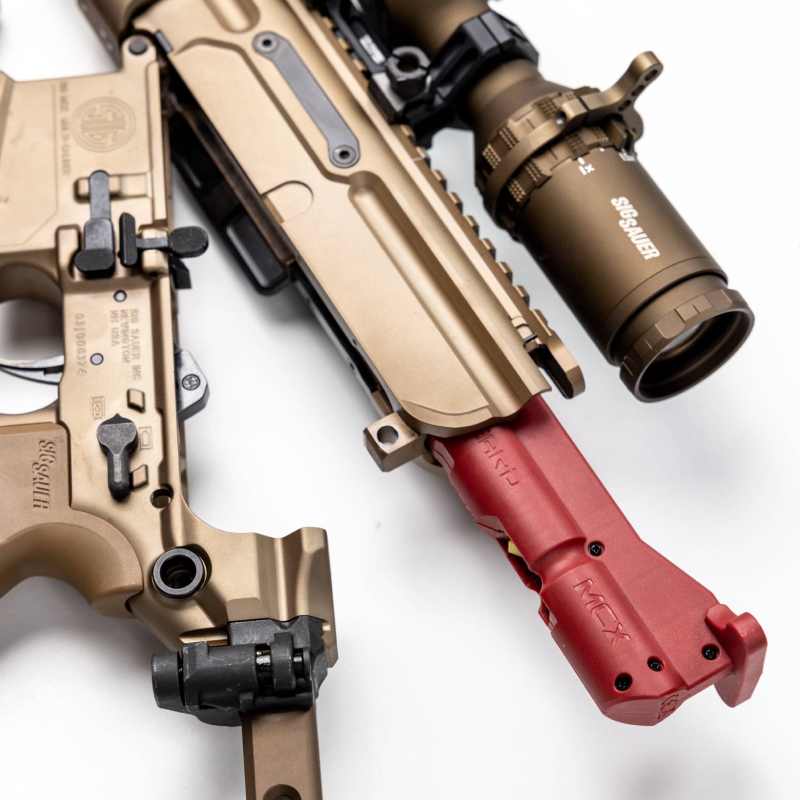
This is the most AR-specific system on the market. The auto-resetting trigger means you can run drills at realistic speed: draw from ready, press, follow through, press again. The app scores each shot and shows your muzzle trace, so you can see exactly when you're pushing, pulling, or jerking. You can run it with the green laser model for shot placement feedback on a target, or without if you're just working trigger press quality.
The downside: it's around $220 for the base unit, and you lose the weight and balance of your actual BCG and loaded magazine. The rifle feels lighter than it should, which matters if you're working transitions or any kind of movement drill. There's also no recoil simulation, every press is a dead trigger with a click and a reset.
MantisX X10 Elite
The X10 is a rail-mounted sensor, not a BCG replacement. It attaches to any Picatinny rail and tracks muzzle movement through the shot cycle. It works with ARs, handguns, shotguns, even archery equipment. The app gives you a shot-by-shot analysis with a numerical score and a muzzle trace showing your movement pattern.
Where the X10 shines is diagnostics. It doesn't just tell you that you missed; it tells you why. The muzzle trace reveals anticipation, trigger jerk, grip pressure changes, and follow-through failures. It works during both dry fire and live fire, so you can compare your dry fire performance directly against your range results.
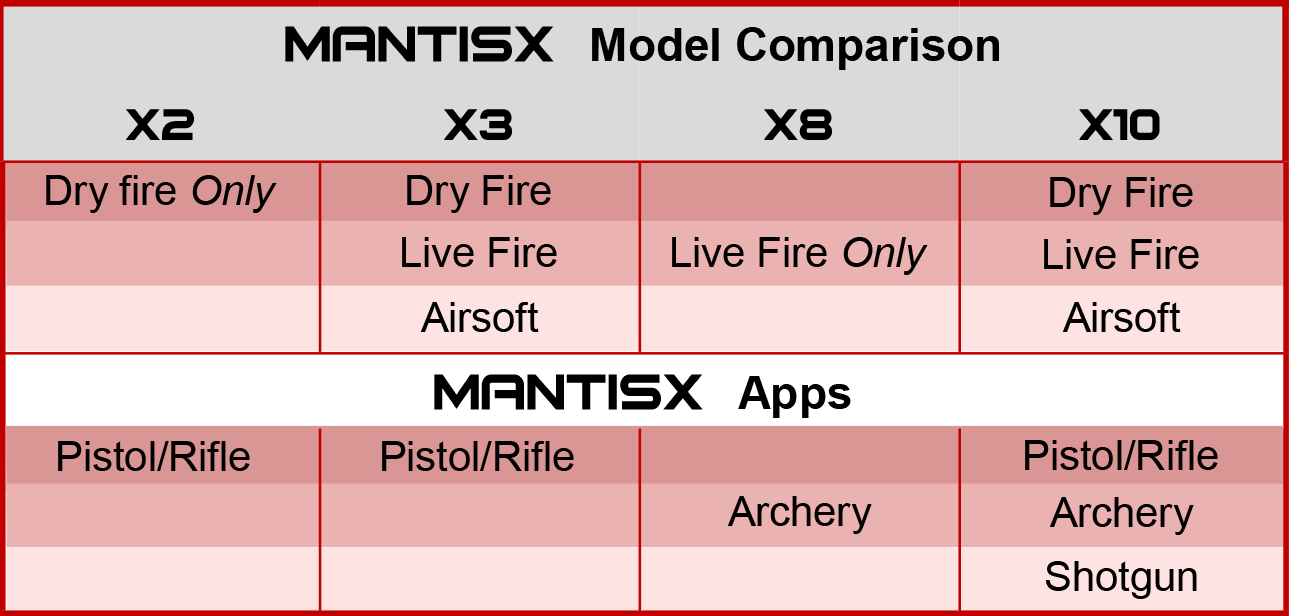
The trade-off is that you still have to manually rack the charging handle between each trigger press on an AR (unless you pair it with a Blackbeard). At roughly $250, it's not cheap, and the value is almost entirely in the data and app ecosystem. If you don't actually review your shot data and work the diagnostics, you're paying for a fancy accelerometer that sits on your rail.
Strikeman laser training system
Strikeman takes a simpler approach. You insert a laser cartridge into your chamber, aim at their proprietary target, and the app on your phone captures where the laser hits when you press the trigger. It gives you a shot group on screen and tracks your accuracy over time.
The appeal is the price, around $100 for the full kit with a phone mount and target. Setup is fast, and the feedback is intuitive: you see your group, you know if you're pulling shots. For AR-15 use, you'll need their 5.56/.223 laser cartridge, and you'll be racking the charging handle between every shot since there's no auto-reset.
The limitation is depth. Strikeman tells you where but not why. There's no muzzle trace, no movement analysis, no scoring of your trigger press mechanics. If you're already a decent shooter working on refining your press, this won't give you much to diagnose. It's a solid entry point for shooters who've never done structured dry fire, but you'll outgrow it.
CoolFire Trainer
This is the outlier. CoolFire replaces your bolt carrier with a gas-powered system that uses CO2 to drive the bolt back when you press the trigger, giving you actual recoil and a cycling action. The AR-15 SideKick package runs around $300 and includes the replacement bolt, a CO2 adapter, and cartridges.
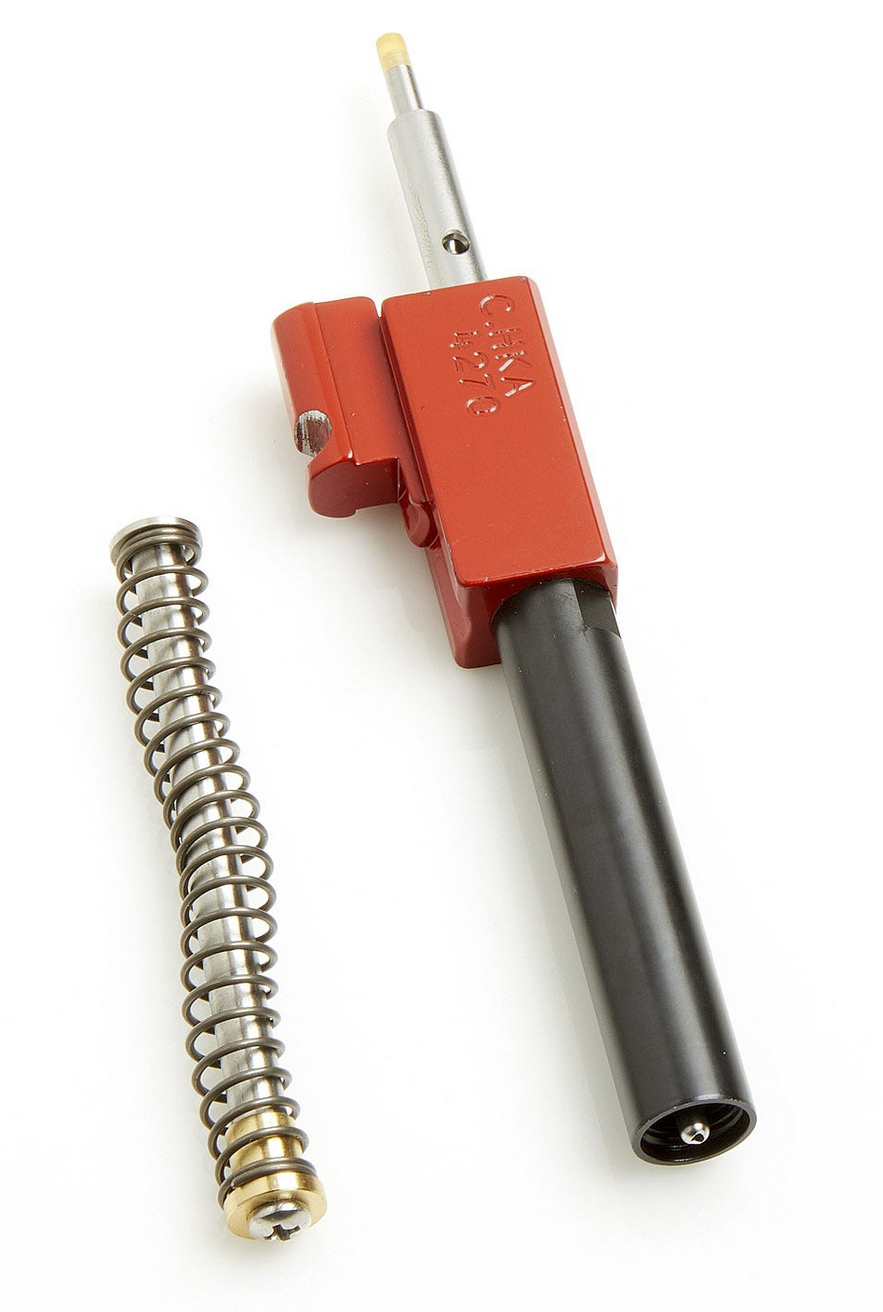
The recoil simulation changes the training equation. You can work recoil management, follow-up shots, and target transitions with something that actually pushes back. The bolt cycles, the trigger resets, and you get a physical sensation closer to live fire than any laser or sensor system can replicate.
The downsides are real though. CO2 cartridges are consumable, you'll get roughly 40 to 80 cycles per cartridge depending on the model, and replacements add up. There's no shot placement feedback and no muzzle tracking data. You're getting the physical experience without the analytical feedback. And the system requires more setup and maintenance than a drop-in laser cartridge.
SIRT AR bolt
Next Level Training makes the SIRT AR bolt, a drop-in BCG replacement with a built-in laser. It fires a red laser on trigger prep (take-up) and a green laser on the break, so you can see exactly where your muzzle is pointed at both stages of the trigger press. No app required, all feedback is visual, right on the wall or target.
The dual-laser system is genuinely useful for diagnosing trigger press issues. If your red dot (prep) is on target but your green dot (break) shifts low-left, you know you're slapping the trigger. It's immediate, visual, and doesn't require staring at a phone screen between reps.
The downside is availability and price. The SIRT AR bolt has been inconsistently stocked, and pricing hovers around $250 to $310 depending on the retailer. Like the Blackbeard, it changes the weight and balance of your rifle. And without app integration, you're relying on your own observation to track progress over time, no stored data, no trend lines, no scores.
Side-by-side comparison
Common mistakes with these systems
Running reps without a plan is still running reps without a plan, even with a $250 gadget attached. Most people buy one of these systems and just press the trigger over and over at a blank wall. That's not training, that's fidgeting.
Another mistake is chasing the score instead of the mechanic. The MantisX app will give you a number, and it's tempting to game it by slowing way down. The score should reflect your current speed standard, not your slowest possible press.
Skipping the fundamentals is the third trap. No system fixes a bad shooting position, a chicken-wing elbow, or a death grip on the handguard. Get your stance and mount right first, then let the system diagnose your trigger press.
How to pick and how to use it
If your biggest gap is trigger press quality and you want data, the Blackbeard or X10 is your move. If you just need basic shot placement feedback and you're budget-conscious, Strikeman gets you started. If you're working recoil management and follow-up shots, CoolFire is the only game in town.
Whatever you pick, run it with a plan. Set a par time. Pick a specific drill, three to five reps from ready to first shot, or a five-shot group at a scaled target. Track your results session to session. Fifty deliberate reps with feedback beat 200 trigger presses at the ceiling. The system is just the tool. The plan is the training.