You pick up a box of 12-gauge shells and the label reads: "3 dram equivalent, 1-1/8 oz, #6 shot, 1,200 fps, 2-3/4 inch." You probably know what some of that means. But "dram equivalent"? That's the term that trips up even experienced shotgunners; and it's just the start. Shotshell terminology is its own dialect, a weird mix of black-powder holdovers, engineering shorthand, and marketing language that doesn't always mean what you'd think.
This is a glossary, but not the alphabetical-and-boring kind. The terms are grouped by where you'd actually encounter them: reading a box, choosing shot material, understanding chokes and patterns, and loading your own. Where a term has practical implications, where misunderstanding it costs you birds or money, there's extra context. Where it's straightforward, the definition is short and we move on.
What's printed on the box
Gauge
Gauge is the bore diameter of the shotgun, measured by an old system: the number of lead balls of that bore diameter it takes to make one pound. A 12-gauge bore uses balls where 12 of them weigh a pound (about .729 inches in diameter). A 20-gauge uses smaller balls where 20 make a pound (.615 inches). The smaller the gauge number, the bigger the bore. The .410 is the oddball, it's actually measured in caliber (inches), not gauge. If it followed the gauge system, it'd be roughly a 67-gauge.
Practical note: gauge determines what shells physically fit your gun, but it also sets the ceiling on payload weight. A 12-gauge can push 2 oz of shot. A 20-gauge tops out around 1-1/4 oz in most hunting loads. That payload difference matters more than gauge alone.
Shell length
Listed in inches (2-3/4", 3", 3-1/2") or millimeters (70mm, 76mm, 89mm). This is the length of the hull after it's been fired and the crimp has opened. An unfired 2-3/4" shell actually measures shorter than 2-3/4 inches because the crimp folds inward. Your chamber length is stamped on the barrel. You can safely shoot shorter shells in a longer chamber, 2-3/4" shells in a 3" chamber, but never the reverse. A 3" shell in a 2-3/4" chamber creates dangerous pressure because the crimp can't open fully.
Shot size
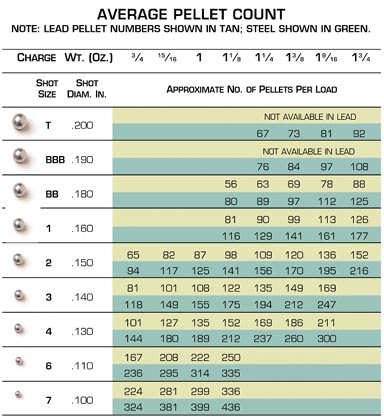
The number on the box (#2, #4, #6, #7-1/2, #8, #9, etc.) corresponds to pellet diameter. Larger numbers mean smaller pellets. #9 shot is .080 inches in diameter; #2 shot is .150 inches. Buckshot uses a different scale: 00 ("double-aught") buck is .330 inches, #4 buck is .240 inches. Don't confuse #4 birdshot (.130") with #4 buckshot (.240"), they're wildly different pellets for wildly different purposes.
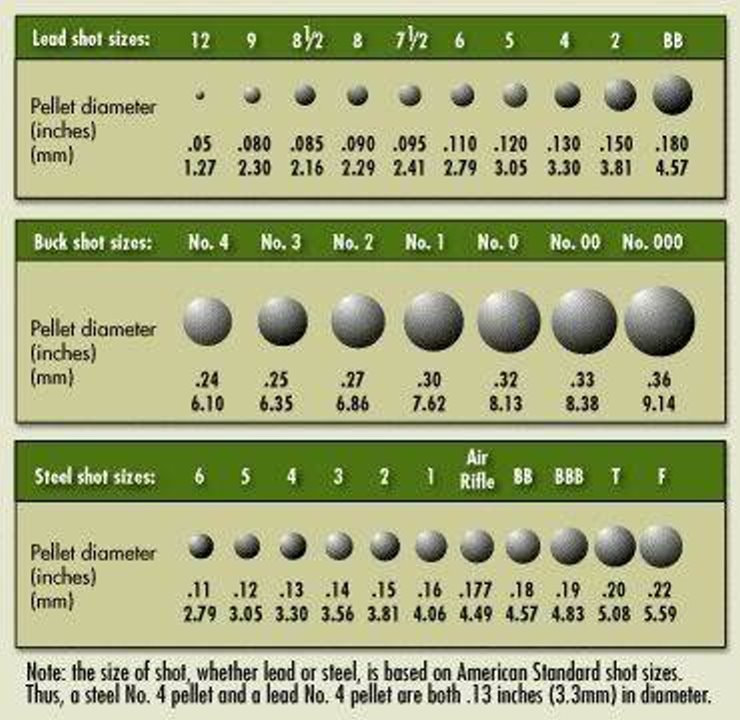
The general rule: smaller pellets give you more pellets per ounce (better pattern density, more chances to hit), but each pellet carries less energy at distance. Larger pellets retain energy farther but give you fewer pellets in the pattern. The game you're hunting and the range you're shooting it at determine the right trade-off.
Payload weight
Listed in ounces (1 oz, 1-1/8 oz, 1-1/4 oz, etc.). This is the total weight of shot in the shell. Heavier payloads put more pellets downrange, but they also increase recoil, and the relationship isn't linear, at some point, more pellets just means more deformed pellets and a messier pattern. A 1-1/8 oz load of #7-1/2 lead contains roughly 394 pellets. Bump to 1-1/4 oz and you're at about 438. That's 44 more pellets, but also noticeably more felt recoil.
Velocity (fps)
Muzzle velocity in feet per second. Typical 12-gauge target loads run 1,145 to 1,200 fps. Field loads push 1,200 to 1,330 fps. Waterfowl steel loads often hit 1,400 to 1,550 fps. Turkey loads with tungsten can range from 1,000 to 1,300 fps depending on payload weight.
Higher velocity doesn't automatically mean better performance. Faster pellets deform more at the moment of setback (the acceleration phase inside the barrel), which can actually open up your pattern. Faster also means more recoil and more noise. For clay targets, 1,200 fps is plenty. The velocity arms race in waterfowl loads exists partly because steel shot loses energy faster than lead, so the extra speed compensates, but there are diminishing returns past about 1,500 fps.
Dram equivalent
Here's where it gets interesting. "Dram equivalent" is the most confusing number on a shotshell box, and it doesn't mean what most people assume.
A dram is a unit of weight from the avoirdupois system, 1/16 of an ounce, or about 27.3 grains. When shotshells used black powder, the powder charge was measured in drams. A load with 3 drams of black powder pushing 1-1/8 oz of shot at a certain velocity was a known quantity.
When smokeless powder replaced black powder, manufacturers needed a way to communicate velocity without confusing shooters who were used to the black-powder system. So they created "dram equivalent", a number that tells you the velocity of the smokeless load as if it were being driven by that many drams of black powder. It's a velocity proxy, not an actual powder charge.
A 3 dram equivalent load with 1-1/8 oz of shot produces roughly 1,200 fps. A 3-1/4 dram equivalent with the same payload is about 1,260 fps. The actual amount of smokeless powder in the shell might be 18 or 19 grains, nowhere near 3 drams (which would be about 82 grains).
The numbers say this: dram equivalent is basically an old-fashioned speedometer. Higher dram equivalent = faster. Many manufacturers are finally just printing the fps on the box and dropping the dram equivalent number entirely. If you see both, trust the fps figure.
Here's a rough chart for 12-gauge loads with 1-1/8 oz of shot:
2-3/4 dram eq. ≈ 1,145 fps
3 dram eq. ≈ 1,200 fps
3-1/4 dram eq. ≈ 1,260 fps
3-1/2 dram eq. ≈ 1,330 fps
3-3/4 dram eq. ≈ 1,400 fps (sometimes listed as "max dram")
"Max dram" or "maximum" on the box just means the load is at the high end of the velocity range for that payload. It's marketing, not a safety designation.
Shot type / material
The box will indicate lead, steel, bismuth, tungsten, or some proprietary alloy. This matters enormously for legality (steel or non-toxic shot is required for waterfowl and in certain areas for upland and dove), for patterning behavior, and for cost. More on each material below.
Shot materials: what they are and why they cost what they cost
Lead
Density: 11.3 g/cm³. The original and still the benchmark. Lead is soft, dense, and cheap. It deforms on setback (the initial acceleration inside the barrel), which is both a flaw and a feature, deformed pellets fly off-line, opening the pattern, but that spread can be desirable at close range on fast birds. Lead is banned for waterfowl hunting federally and increasingly restricted for upland hunting in certain states and on certain public lands. Check your local regs.
Steel
Density: 7.8 g/cm³. About 30% less dense than lead. Steel pellets don't deform, which sounds good until you realize it means they don't "give" against each other in the shot column, creating more uniform but sometimes tighter-than-expected patterns. The lower density means each pellet carries less energy at distance, so the standard advice is to go up two shot sizes from what you'd use in lead. If you'd shoot #4 lead for ducks, use #2 steel. Steel is the cheapest non-toxic option and the most widely available.
Steel is hard on old barrels and fixed chokes not rated for it. If your gun was made before the mid-1980s or has Damascus barrels, consult the manufacturer before running steel through it.
Bismuth
Density: 9.8 g/cm³. Sits between steel and lead in density, and it's non-toxic. Bismuth is brittle, pellets can fracture on impact or even during setback, but modern bismuth loads use buffering and better alloys to minimize breakage. The big advantage: bismuth is safe for older guns and tighter chokes where steel isn't recommended. The big disadvantage: cost. Bismuth loads typically run 2 to 3 times the price of steel.
Tungsten-based alloys (TSS, HTL, ITX, etc.)
Density varies by alloy. Tungsten Super Shot (TSS) is about 18.1 g/cm³, roughly 60% denser than lead. That extreme density means a #9 TSS pellet carries energy comparable to a #5 lead pellet, which lets you pack dramatically more pellets into a given payload weight while maintaining lethal energy at distance. TSS has transformed turkey hunting and is making inroads in waterfowl.

The cost math: TSS loads can run $5 to $10+ per shell. For turkey hunting where you might fire one or two shells a season, that's a non-issue. For a waterfowl hunt where you're burning a box or more per outing, it gets expensive fast. Blended loads (TSS mixed with steel or bismuth) split the difference.
Tungsten-iron and tungsten-matrix
These are older tungsten-based alternatives with densities in the 10 to 12 g/cm³ range, denser than steel but not as extreme as TSS. They pattern well, they're non-toxic, and they're gentler on barrels than steel. Pricing falls between steel and bismuth.
Copper-plated lead
Still lead at its core, with a thin copper jacket. The plating reduces deformation during setback, which tightens patterns and improves consistency. Common in premium upland and turkey loads. Not legal where non-toxic shot is required, it's still lead.
Nickel-plated lead
Same concept as copper plating but with nickel. Reduces pellet-to-pellet friction in the shot column. Federal's Premium line uses nickel-plated lead in many of their hunting loads.
Inside the shell: anatomy terms
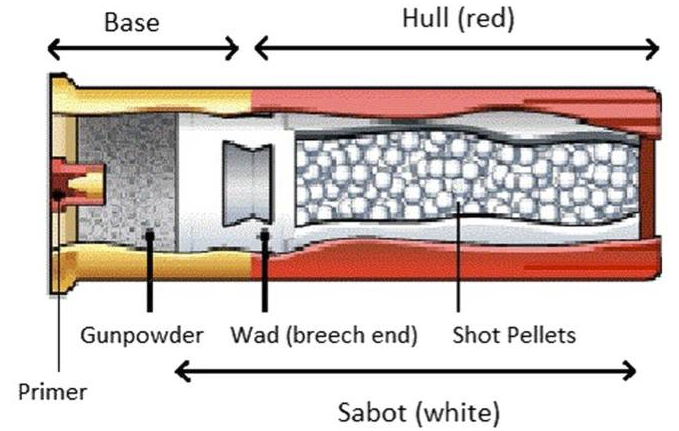
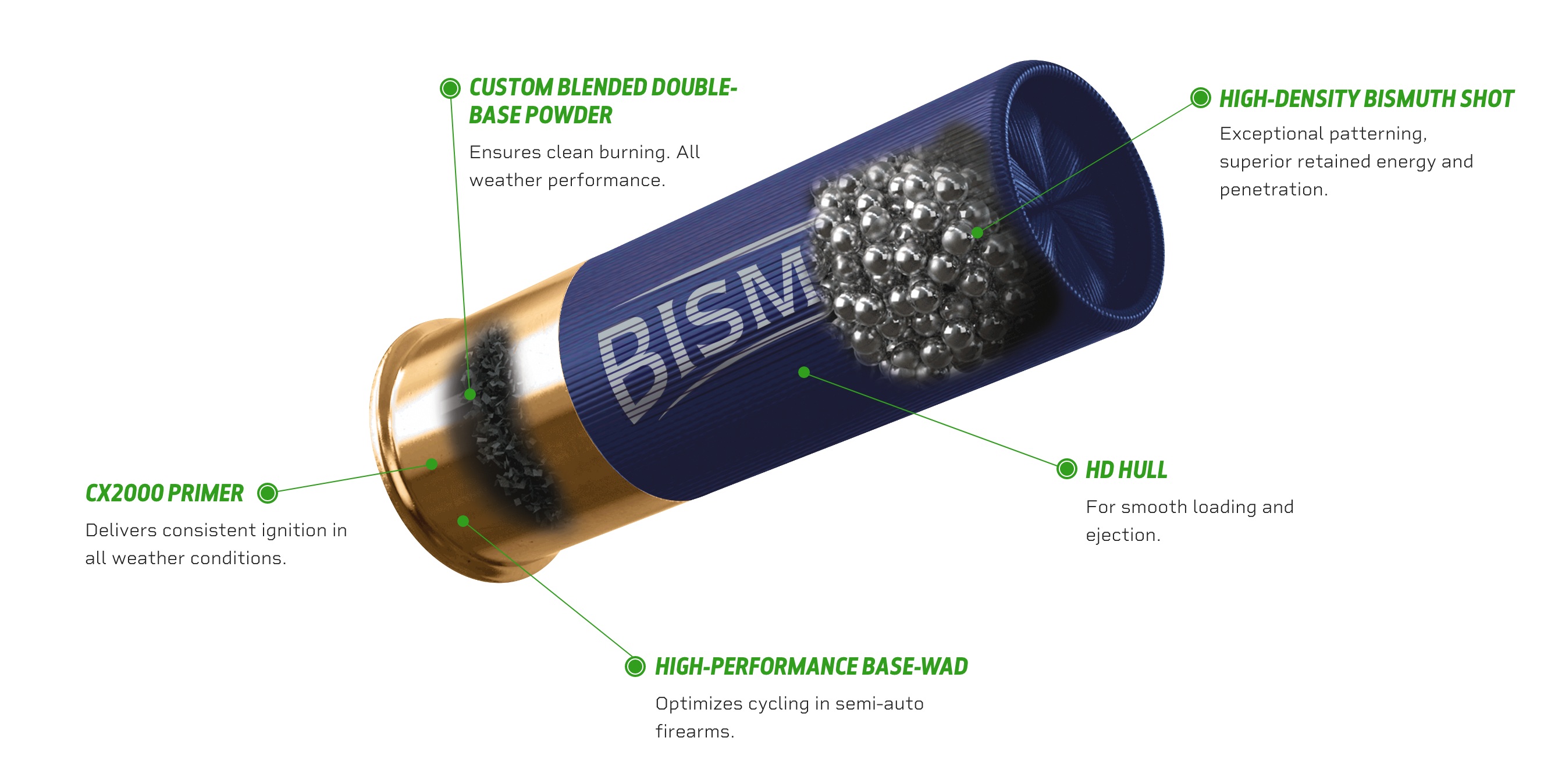
Hull
The plastic (or sometimes paper) body of the shell. Hulls come in high-brass and low-brass configurations, which refers to the height of the brass head at the base. Here's what the marketing doesn't mention: brass height is largely cosmetic in modern shells. It doesn't reliably indicate power level. Manufacturers have used high-brass on hotter loads as a visual signal, but the actual structural difference is minimal. The hull material and internal components determine performance, not the brass height.
Primer
The small metal cup in the center of the base that ignites when struck by the firing pin. Shotshell primers are larger than centerfire rifle/pistol primers. Standard shotshell primers (like Winchester 209s) are the most common. Some specialty primers are designed for cleaner ignition with specific powder types.
Powder charge
The propellant. Measured in grains for reloading purposes but not listed on factory ammo boxes (you get dram equivalent or fps instead). Shotshell powders are typically fast-burning compared to rifle powders because they need to accelerate a heavy, low-pressure payload in a relatively short barrel.
Wad
This is the plastic (or fiber) component that sits between the powder and the shot. Modern one-piece wads combine three functions: they seal gas behind the shot (the gas seal or obturator), they cushion the shot during acceleration (the cushion section, which compresses to absorb setback force), and they contain the shot in a cup during its trip down the barrel (the shot cup). The wad separates from the shot shortly after leaving the muzzle.
Wad design has a huge effect on patterns. Shot cups with integrated petals that peel back control how quickly the shot spreads. Some wads have slits cut into the petals to open earlier; others are designed to stay closed longer for tighter patterns. Fiber wads (used in some hunting loads and required at some shooting venues for environmental reasons) don't contain the shot as well, so patterns tend to be more open.
Shot buffer
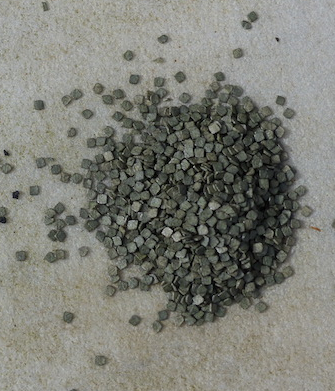
Granulated plastic material packed into the spaces between pellets inside the shot cup. Buffer reduces pellet deformation by preventing pellets from smashing against each other during setback. Less deformation means more round pellets, which means more pellets fly true, which means denser, more uniform patterns.
Shot buffer is common in premium hunting loads, turkey loads especially. It's one of the cheapest ways to improve pattern quality. Reloaders can buy buffer material (it looks like tiny plastic granules) and add it to their loads. The trade-off: buffer takes up space, so a buffered load may hold slightly less shot by volume, though manufacturers account for this in their load data.
Crimp
The closure at the mouth of the hull. Two types: star crimp (the standard folded closure you see on most shells, typically 6- or 8-fold) and roll crimp (where the hull mouth is rolled inward over a card wad, common on slug loads and some buckshot). Star crimps release more consistently and are easier to manufacture. Roll crimps are used when the payload is too tall for the hull to fold over properly.
Headstamp
The markings stamped into the brass base of the shell. Usually includes the manufacturer, gauge, and shell length. On reloading hulls, the headstamp helps identify the hull type, which matters because different hulls have different internal volumes and require different load data.
Base wad
An internal structure molded into the base of the hull that forms the powder chamber. Base wad height varies between hull types and directly affects internal volume. This is mostly a reloader's concern, a hull with a tall base wad holds less powder and shot than one with a short base wad, even if they're the same length externally.
Chokes, patterns, and the terms that describe them
Choke
A constriction at the muzzle end of the barrel that controls how tightly the shot column stays together as it leaves the gun. Tighter choke = tighter pattern at a given distance. Chokes are either fixed (built into the barrel) or interchangeable (screw-in tubes).
Choke constriction designations
From most open to tightest, the standard designations are:
Cylinder (no constriction), Skeet, Improved Cylinder, Light Modified, Modified, Improved Modified, Full, Extra Full, and Turkey (sometimes called Super Full). Each step tighter adds roughly .005" of constriction in a 12-gauge, though this varies by manufacturer.
The actual constriction in thousandths of an inch matters more than the name. One manufacturer's "Modified" might be .020" constriction; another's might be .018". If you're serious about patterning, measure your choke tubes with calipers.
Pattern percentage
The percentage of pellets from a given load that land inside a 30-inch circle at 40 yards. This is the standard metric for choke performance. A Full choke is nominally defined as putting 70% of pellets in that circle. Modified is about 60%. Improved Cylinder is about 50%. Cylinder is about 40%.
These are guidelines, not laws. Different loads pattern differently through the same choke. A buffered, copper-plated #6 lead load through a Modified choke might pattern tighter than a cheap #6 field load through a Full choke. The only way to know what your gun and load combination actually does is to pattern it.
Patterning
The process of shooting at large paper targets (usually 36" or 48" sheets) at a set distance (typically 40 yards for hunting, 20-25 yards for home defense) and counting pellet hits inside a defined circle. Serious patterning means shooting multiple rounds, at least five, and averaging the results. One shot can be a fluke.
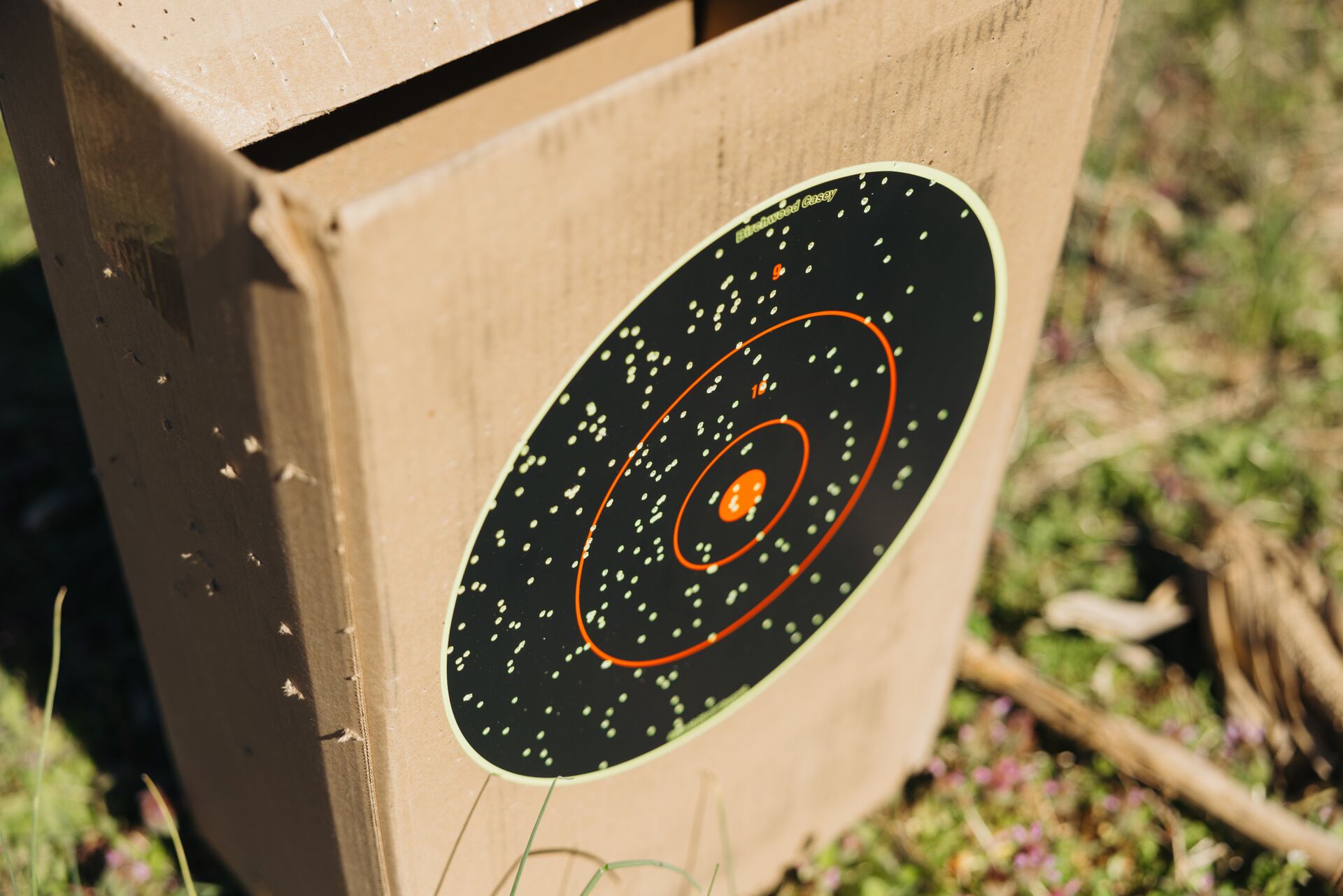
What you'll see: even experienced shotgunners are surprised the first time they pattern a gun. Patterns are rarely centered exactly where you'd expect, and the distribution of pellets is never perfectly even. You're looking for consistent density without large gaps (holes big enough for a bird to fly through). You're also checking point-of-impact relative to point-of-aim, some guns shoot high, some shoot flat.
Pattern density
The number of pellets per unit area within the pattern. Raw pattern percentage doesn't tell the whole story. A 70% pattern with even distribution is better than a 75% pattern with a dense core and thin edges. For hunting, you want enough pellets in the vital zone of the target animal at your expected range. For turkey, that's typically 100+ pellets in a 10-inch circle at 40 yards with a tight choke. For doves at 30 yards, you want a wider, more forgiving spread.
Point of impact (POI)
Where the center of the pattern actually hits relative to where you aimed. Shotguns intended for wingshooting (field guns, sporting clays guns) are often designed to shoot slightly high, 60/40 or 70/30 (meaning 60-70% of the pattern is above the aim point). Trap guns shoot even higher. Slug guns and tactical shotguns are typically set up for 50/50 (dead-on). POI can shift between different loads.
Shot string
The three-dimensional length of the shot cloud as it travels downrange. Shot doesn't arrive at the target as a flat disk, it's an elongated cloud, with the front pellets arriving before the rear pellets. Shot string length increases with distance. A typical 12-gauge load might have a shot string 8 to 12 feet long at 40 yards. For stationary targets (turkey, patterning paper), shot string doesn't matter much. For crossing birds, a longer shot string can actually help because the bird is moving through the cloud over time. But this is debated endlessly, and the practical effect is small compared to pattern density and lead.
Effective range
The maximum distance at which a given load delivers enough pellets with enough energy to cleanly kill the intended target. This isn't a single number, it depends on the choke, the shot size, the shot material, the specific game, and your personal standard for what constitutes a clean kill. For most birdshot loads on upland birds, effective range is 30 to 45 yards. For steel waterfowl loads, it's typically 35 to 50 yards depending on shot size. For TSS turkey loads through tight chokes, some hunters stretch to 50-60 yards, though that's controversial.
Pellet energy
The kinetic energy of an individual pellet at a given distance, usually expressed in foot-pounds. A single #2 steel pellet at 40 yards carries roughly 3.5 to 4 ft-lbs. A #BB steel pellet at the same distance carries about 6 ft-lbs. The commonly cited minimum for waterfowl is around 2 to 3 ft-lbs per pellet, with multiple pellets needed in the vital zone. These numbers vary by source and velocity assumptions, so treat them as ballpark figures.
Setback
The force exerted on the shot charge during the initial acceleration phase when the powder ignites. This is the moment when pellets get deformed, the rearmost pellets are crushed against the ones in front of them. Setback forces are higher in faster loads. Shot buffers, harder shot materials (copper-plated lead, steel, tungsten), and wad design all mitigate setback deformation.
Slug and buckshot terms
Slug
A single large projectile fired from a shotgun. Common types include Foster slugs (the classic "rifled slug" with hollow base and rifling-like grooves on the outside, the grooves don't actually spin the slug much, they're mainly there to allow the slug to safely pass through a choke), Brenneke slugs (solid body with attached wad, generally heavier and harder-hitting than Foster slugs), and sabot slugs (a smaller-diameter projectile encased in a plastic sabot that falls away after leaving the barrel, designed for rifled shotgun barrels).
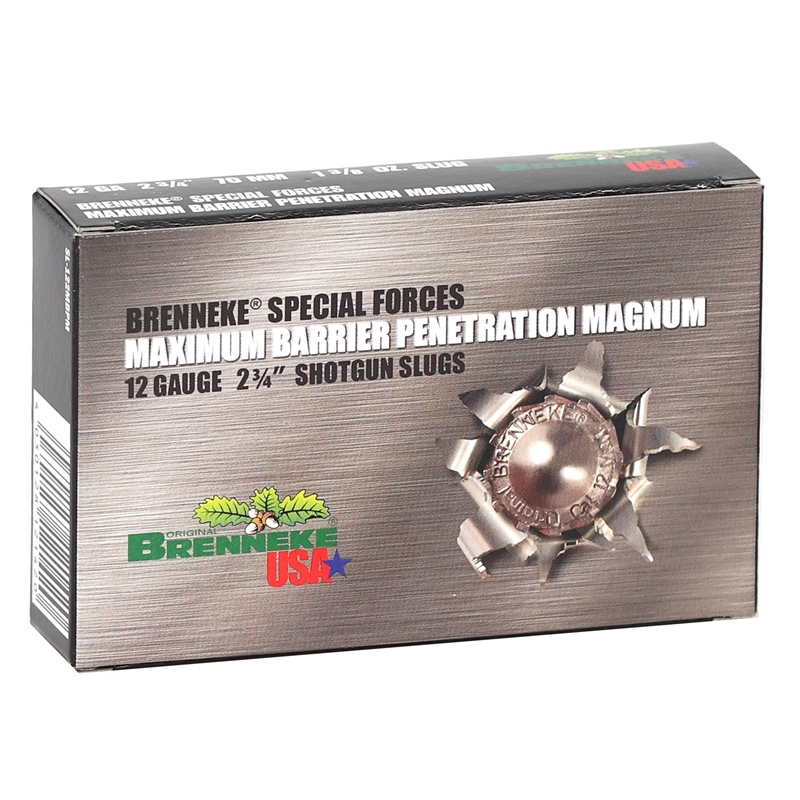
Foster and Brenneke slugs work in smoothbore barrels and are typically accurate to 75-100 yards. Sabot slugs from rifled barrels can stretch to 150-200 yards with good accuracy. Don't shoot sabot slugs through a smoothbore, they won't stabilize. Don't shoot Foster slugs through a rifled barrel, the lead fouls the rifling and accuracy degrades quickly.
Buckshot
Multiple large pellets, sized from #4 buck (.240") up to 000 ("triple-aught") buck (.360"). The standard defensive/law enforcement load is 00 buck in 2-3/4" 12-gauge, typically containing 8 or 9 pellets at around 1,200 to 1,325 fps. Buckshot patterns open up fast, at 25 yards, a cylinder-bore gun might spread 00 buck into a 20-inch or wider pattern. Patterning your specific gun with your specific buckshot load is critical for home defense. The variation between guns is enormous.
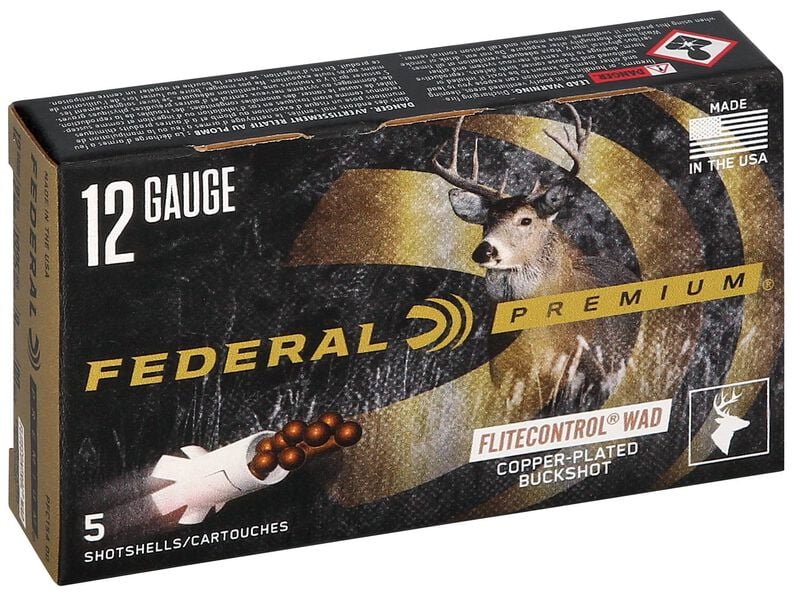
Flight control wad
A patented Federal design (used in their FliteControl line) where the wad stays with the shot column longer after leaving the barrel, dramatically tightening buckshot patterns. A FliteControl 00 buck load can keep all 8 pellets inside 8-10 inches at 25 yards from a cylinder-bore gun, compared to 18-24 inches for conventional loads. Hornady's Versatite wad does something similar. These loads have basically redefined what's possible with defensive buckshot.
Plated buckshot
Buckshot pellets with a copper or nickel coating. Same principle as plated birdshot, reduced deformation, more consistent patterns. Most premium defensive buckshot is plated.
Reloading-specific terms
Hull life
The number of times a hull can be reloaded before it cracks, splits, or the primer pocket loosens. High-quality hulls like Remington STS or Winchester AA can handle 8-15 reloads if you're careful. Cheap promotional hulls might only last 2-3 reloads. Hull life depends on the load pressure, how aggressively your gun's chamber and ejector treat the hull, and how well you resize.
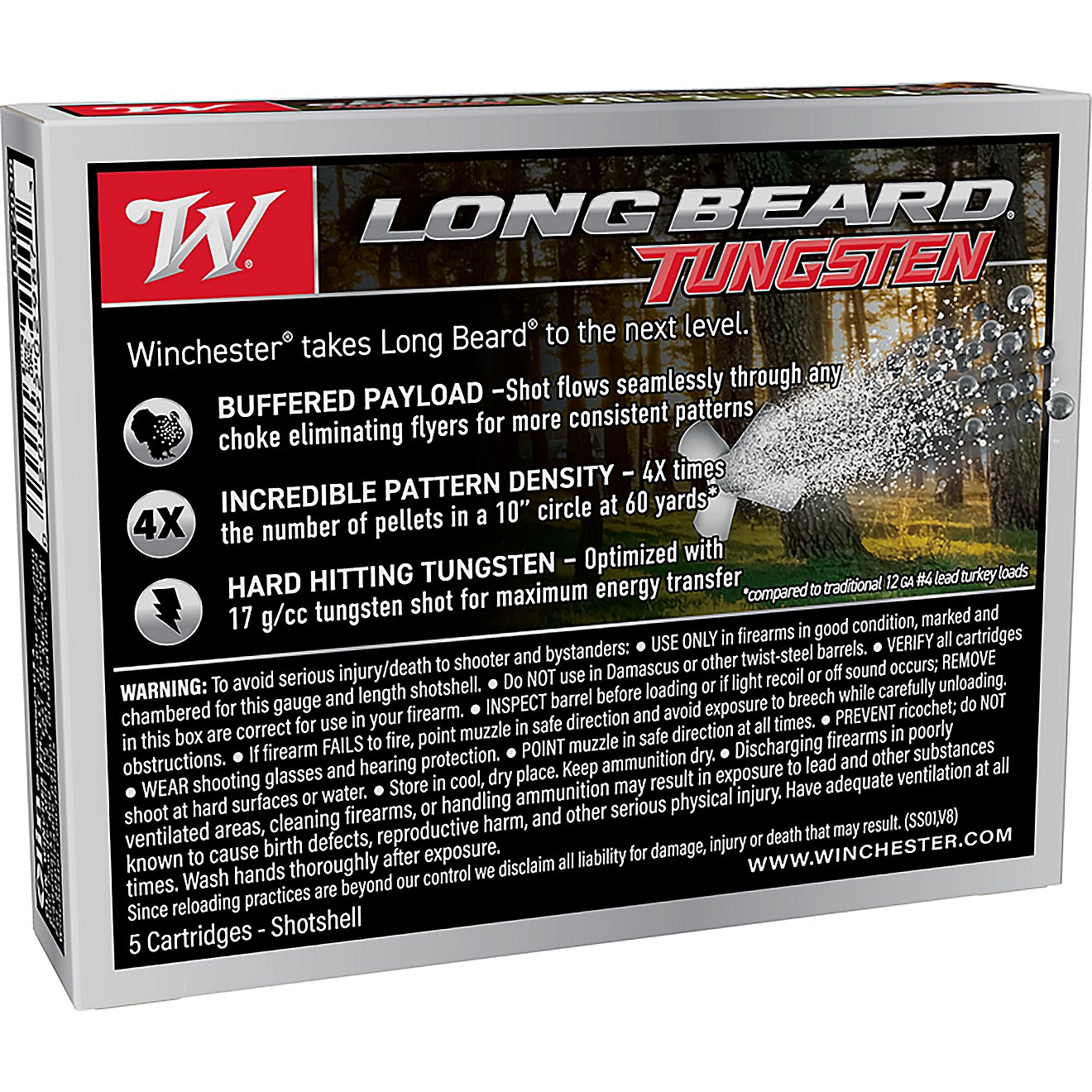
Winchester Long Beard Tungsten Shotshell Deals
Prices may change. May contain affiliate links.
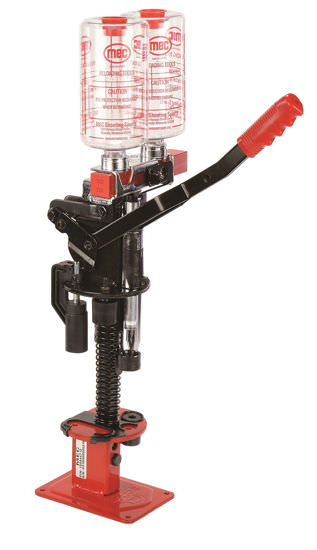
Bushing
In shotshell reloading presses, a bushing is a measured insert that controls how much shot or powder drops into the hull. Different bushing numbers correspond to different charge weights. Getting the right bushing for your recipe is critical, shotshell loads are pressure-sensitive, and even small variations in charge weight can push pressures outside safe limits.
Fold crimp vs. roll crimp
Already covered above, but from a reloading perspective: star/fold crimps require the hull mouth to be in good condition. If the hull mouth is cracked or wrinkled, the crimp won't seal properly and you'll get inconsistent ignition and velocity. Roll crimps require a separate over-shot card and a roll-crimping tool.
Recipes / load data
Shotshell reloading is not like metallic cartridge reloading. You cannot freely substitute components. A recipe specifies a particular hull, primer, powder type, powder charge, wad, and shot weight. Changing any one component can dramatically alter pressure. Shotshell pressures are measured in PSI (or sometimes in the older LUP, Lead Units of Pressure, system), and the margin between a safe load and a dangerous one is narrower than most people realize. Use published load data from powder manufacturers. Don't improvise.
Specialty and marketing terms
High-velocity / hyper-velocity
Marketing terms for loads faster than standard velocity for that payload weight. There's no industry-standard definition. A "high velocity" 12-gauge 1-1/8 oz load might be 1,300 fps; a "hyper velocity" might be 1,400+. The velocity is on the box, read the number, ignore the adjective.
Low-recoil / managed recoil
Loads specifically designed to reduce felt recoil, usually by reducing velocity, payload weight, or both. Common in defensive shotgun loads (Hornady Reduced Recoil 00 buck runs about 1,100 fps vs. 1,300 fps for standard) and target loads. The pattern and terminal performance trade-offs are real but often acceptable for their intended use. A low-recoil 00 buck load that you can shoot accurately and follow up quickly is more effective than a full-power load that makes you flinch.
Duplex / blended loads
Shells loaded with two different shot sizes. The idea is to combine the pattern density of smaller shot with the energy retention of larger shot. TSS/steel blends for waterfowl are the most common current example, #4 steel mixed with #9 TSS, for instance. The TSS provides the long-range pellet energy while the steel fills in pattern density at closer ranges. Some of these work well. Some are gimmicks. Pattern them before you trust them.
Spreader loads
Loads designed to open the pattern faster than normal, using internal devices (X-shaped dividers in the shot cup, for example) or special wads. Useful for close-range shooting, early-season grouse in thick cover, skeet shooting. Not common in factory ammo anymore but still available from some manufacturers and popular with reloaders.
Wad-stripping
What happens when a choke or barrel feature causes the wad to separate from the shot column earlier than intended. Some ported barrels or certain choke designs can strip the wad prematurely, which may open the pattern. This can be desirable or not, depending on your goals.
Non-toxic
Any shot material approved by the U.S. Fish & Wildlife Service as non-toxic for waterfowl hunting. Currently approved materials include steel, bismuth, tungsten-iron, tungsten-matrix, tungsten-polymer, tungsten-nickel-iron, and several proprietary alloys. Lead is not non-toxic. Copper-plated lead is not non-toxic. If the box doesn't say "non-toxic" and you're hunting waterfowl, don't use it.
SAAMI
The Sporting Arms and Ammunition Manufacturers' Institute. They set the pressure and dimensional standards for ammunition in the United States. When a shotshell box says it meets SAAMI specs, it means the load has been designed to stay within the maximum average pressure for that gauge and shell length. For 12-gauge 2-3/4", that's 11,500 PSI. For 12-gauge 3", it's also 11,500 PSI. For 12-gauge 3-1/2", it's 14,000 PSI.
CIP
The European equivalent of SAAMI (Commission Internationale Permanente pour l'Epreuve des Armes à Feu Portatives). CIP uses different testing methods and pressure limits than SAAMI. European-loaded shells may be marked with CIP proof marks. The standards are broadly compatible but not identical.
Proof load
A deliberately over-pressure load used to test a barrel's strength. Proof loads generate roughly 30% more pressure than the maximum service load. A gun that passes proof testing is marked with a proof stamp. This is a manufacturing/testing term, you'll never encounter proof loads at a retail level, but the proof marks on your barrel tell you the gun was tested.
Comparison: five 12-gauge waterfowl loads and what the jargon means in practice
Putting all these terms together, here's how five different 12-gauge 3" waterfowl loads compare, and what the label jargon actually translates to in the blind.
Federal Speed-Shok runs #2 steel at 1,550 fps with a 1-1/8 oz payload. It's a high-velocity steel load with a standard wad. The speed compensates for steel's lower density, but the light payload means fewer pellets, around 125 #2 steel pellets per 1-1/8 oz. Recoil is moderate. This is the budget waterfowl option and it works fine inside 40 yards on ducks over decoys.
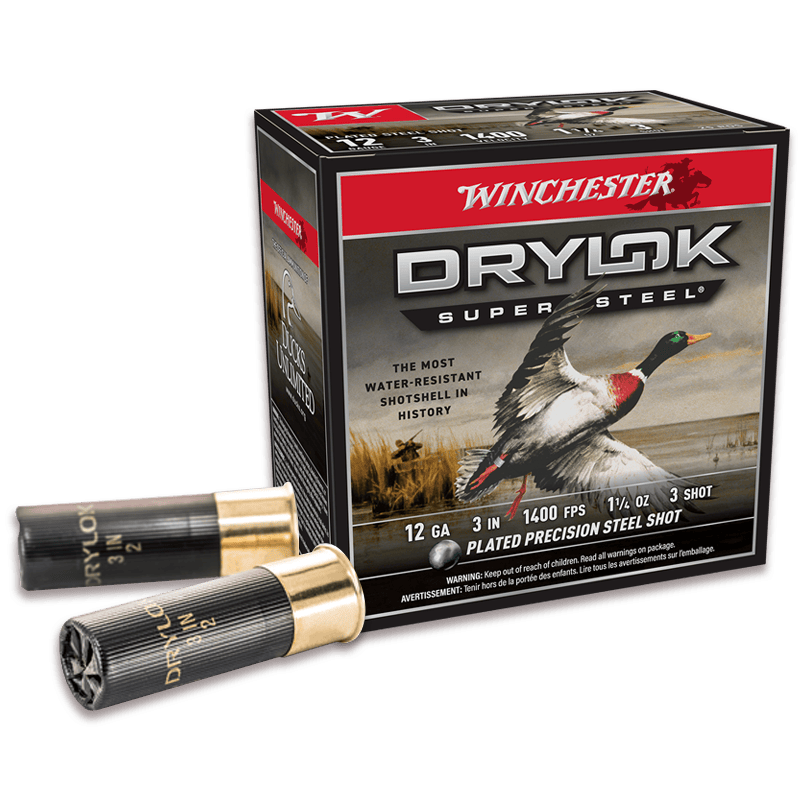
Kent Fasteel 2.0 pushes 1-1/4 oz of #3 steel at 1,450 fps. The slightly heavier payload and smaller shot size give you more pellets (roughly 158 per load) at a modest velocity penalty. Kent's zinc-plated steel is slightly harder than standard steel, which they claim reduces barrel wear. The pattern density advantage over the lighter Speed-Shok load is real and measurable at 35-40 yards.
Boss Bismuth loads 1-1/4 oz of #4 bismuth at 1,350 fps. Bismuth's density (9.8 g/cm³ vs. steel's 7.8) means #4 bismuth hits closer to #4 lead than #4 steel does. You get roughly 135 pellets per 1-1/4 oz, each carrying more energy at 40 yards than a #2 steel pellet of the same velocity. Safe for older guns and tight chokes. The per-shell cost is roughly double the steel loads.
Federal Black Cloud TSS Blend mixes #3 steel with #9 TSS in a 3" shell. The TSS pellets are tiny but incredibly dense, each #9 TSS pellet carries energy comparable to a #5 lead pellet. The steel fills in the pattern at closer ranges while the TSS reaches out. This is a duplex/blended load and it's priced between straight bismuth and straight TSS.
Apex TSS runs a 1-1/2 oz payload of straight #4 TSS at around 1,280 fps. At 18.1 g/cm³, the density means fewer pellets are needed for equivalent energy, but the heavy payload and extreme density still deliver devastating pattern density. This is the premium end, $7+ per shell, and it's overkill for decoying ducks at 25 yards. Where it shines is on geese at 45-50 yards, where the energy retention of TSS keeps pellets lethal well past where steel fades.
Common mistakes and misunderstandings
Confusing shot size systems is the most common error. Someone buys #4 buckshot thinking it's #4 birdshot, or grabs #2 steel thinking it patterns like #2 lead. Steel #2 is physically the same diameter as lead #2, but it weighs less per pellet and loses energy faster. The "go up two sizes" rule for steel vs. lead exists for a reason.
Reading dram equivalent as a powder charge leads to confusion. A 3-1/4 dram equivalent load does not contain 3-1/4 drams of powder. It contains whatever amount of smokeless powder produces the same velocity as 3-1/4 drams of black powder would have. If the box also lists fps, just use that number.
Assuming all chokes of the same name perform the same is a patterning trap. A Carlson's Modified and a Beretta factory Modified may have different actual constrictions. Measure them. Pattern them. The name is a starting point, not a guarantee.
Shooting steel through chokes tighter than Modified without verifying compatibility can damage your choke or barrel. Most modern guns and aftermarket choke tubes are rated for steel, but check. Older fixed-choke guns with Full choke and steel shot are a bad combination, the hard pellets can't compress through the tight constriction the way lead does, and you risk bulging the barrel.
Neglecting to pattern your defensive shotgun is surprisingly common. People buy 00 buck, load it up, and assume it'll put all pellets center-mass at home-defense distances. Some gun/load combinations throw patterns that are already 12-18 inches wide at 15 yards. Others stay tight to 7 inches. You can't know without shooting paper, and every pellet that misses is a liability.
Chrono notes: what velocity variation tells you about shotshells
Velocity spread in shotshells is typically wider than in metallic cartridges. A standard deviation of 15-20 fps is good for shotshells; 25-30 fps is common in budget loads. Extreme spread (the difference between the fastest and slowest round in a string) of 50-80 fps is normal.
Why does this matter? Velocity variation translates to pattern variation. A shell that's 50 fps slower than average will pattern slightly differently than one that's 50 fps faster. For clay targets and hunting, this variation is usually within acceptable limits. For turkey hunting at extended range, where you're trying to stack pellets into a 10-inch circle, tighter velocity consistency helps. Premium turkey loads from Federal, Apex, and others tend to show tighter velocity spreads than budget field loads, and that's part of what you're paying for.
If you're chronographing shotshells, use a chronograph that can handle the shot cloud without getting destroyed. Set it well forward of the muzzle, at least 10 feet, and be aware that the wad can trigger